Creative design for distinctive digital products
Discover how creative design unites product strategy, UX, brand, interaction, and frontend craft to build distinctive digital products that perform. Learn more.
By Ajay Khatri ·
TL;DR
Creative design turns an original idea into a useful, understandable, and feasible digital experience. It connects product strategy, UX, interface craft, brand expression, interaction, and frontend execution. At amajaying.com, we aim for distinction without confusion: products should have a clear point of view while remaining accessible, practical, and easy to use.
Table of Contents
- TL;DR
- What is creative design in digital products?
- How to create a creative design without sacrificing usability
- Why safe decisions make digital products look the same
- The building blocks of a distinctive interface
- Creative UX patterns that improve clarity and conversion
- Why UX, UI, and frontend execution belong together
- How to measure the impact of creative design
- How to evaluate and hire a creative product designer
- Creative design FAQs
- FAQ
- Create a product people remember
What is creative design in digital products?
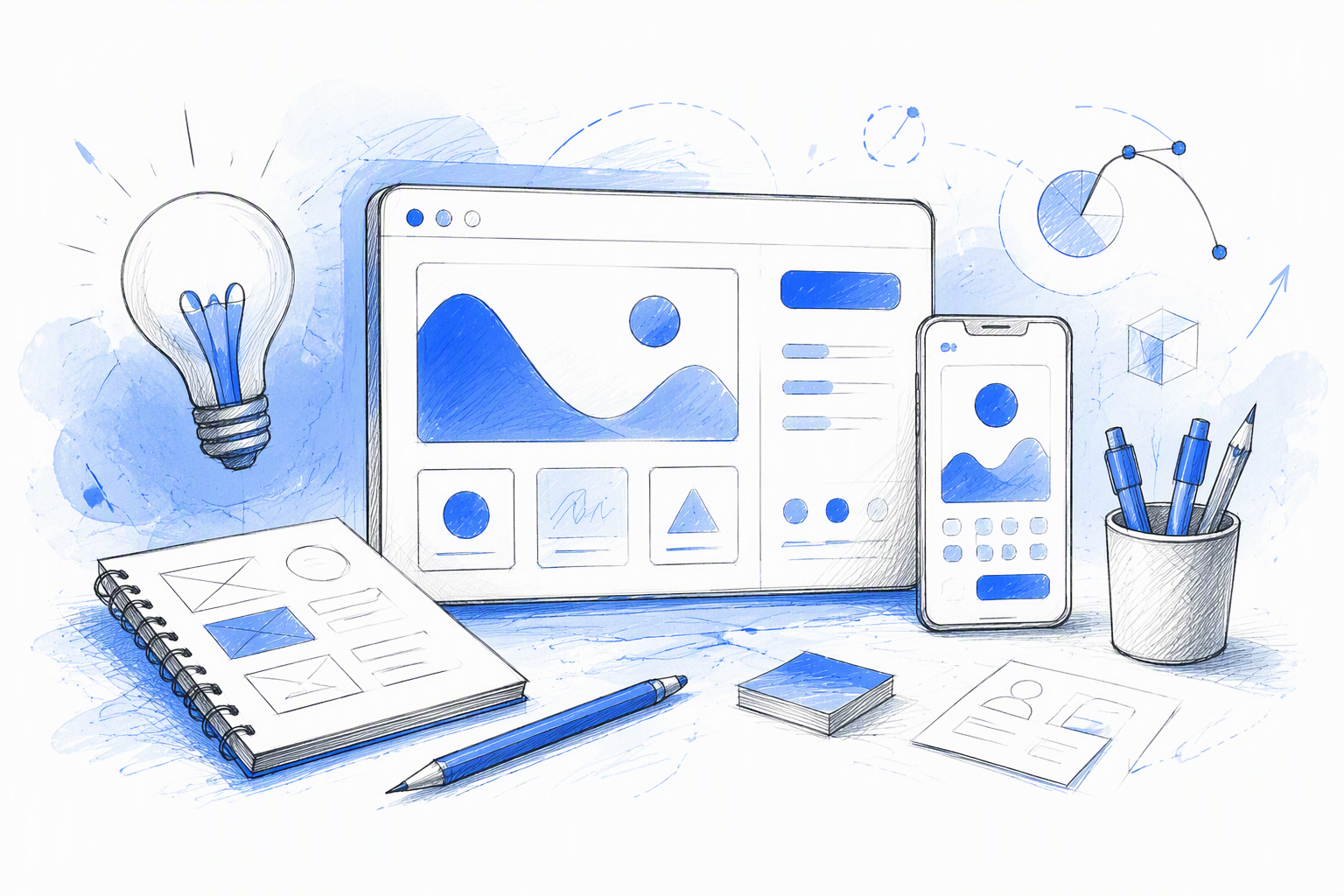
Creative design is decision-making across UX, UI, content, brand, interaction, and implementation. It is not decoration added after the product works.
Our focus is digital design for websites, apps, SaaS platforms, and interactive products. These products need more than visual originality. They must account for usability, accessibility, responsive behaviour, technical constraints, and business goals.
At amajaying.com, we use creativity to make products distinctive without making them harder to understand. The product needs a point of view that people can recognise and act on.
Creativity, visual style, and design problem-solving are not the same
Creativity generates possibilities. Visual style expresses a point of view through typography, colour, composition, imagery, motion, and language.
Design problem-solving evaluates those possibilities against real constraints. An unusual interface is not automatically creative. If it obstructs comprehension or task completion, novelty has displaced purpose.
Design Crawl describes a similar balance: work should feel fresh while remaining understandable to its intended audience.
Why creative design matters for products that feel interchangeable
Templates and established patterns can support efficient delivery, but relying on them too heavily often creates generic experiences. The same grids, type hierarchies, components, and interactions begin to appear everywhere.
Useful distinction can strengthen positioning, recognition, value communication, and decision-making. That does not require making every screen dramatic. It means aligning the interface’s hierarchy, language, behaviour, and visual character with a specific product promise.
How to create a creative design without sacrificing usability
We start with the user problem and desired behaviour, not a moodboard. First, define what people need to understand or complete. Then identify the expected category solution and decide where convention helps.
Originality works best when concentrated in meaningful moments. Navigation, feedback, and primary controls should remain clear. Our end-to-end UI UX design service workflow explains how we connect product goals, validation, interface decisions, and production.
A practical process is:
- Define the user problem and desired behaviour.
- Map the conventional response.
- Generate alternatives around the most valuable decision.
- Select a direction using clear criteria.
- Prototype risky interactions early.
- Test comprehension and feasibility.
- Refine the system without removing its central idea.
Challenge one assumption at a time
List the assumptions behind the current experience. A dashboard may assume every metric needs a card. Onboarding may assume every concept needs explaining before someone can act.
Choose one assumption that could unlock clarity or momentum. Ask whether information needs equal visual weight, whether a process needs several pages, or whether detail could appear only when relevant.
Let user feedback reveal friction—not vote on the design
Research can reveal confusion, hesitation, unmet expectations, and language gaps. It should inform the direction rather than reduce every choice to the safest consensus.
Users help us identify where an idea fails. The design team remains responsible for interpreting that evidence and creating a coherent response.
Why safe decisions make digital products look the same
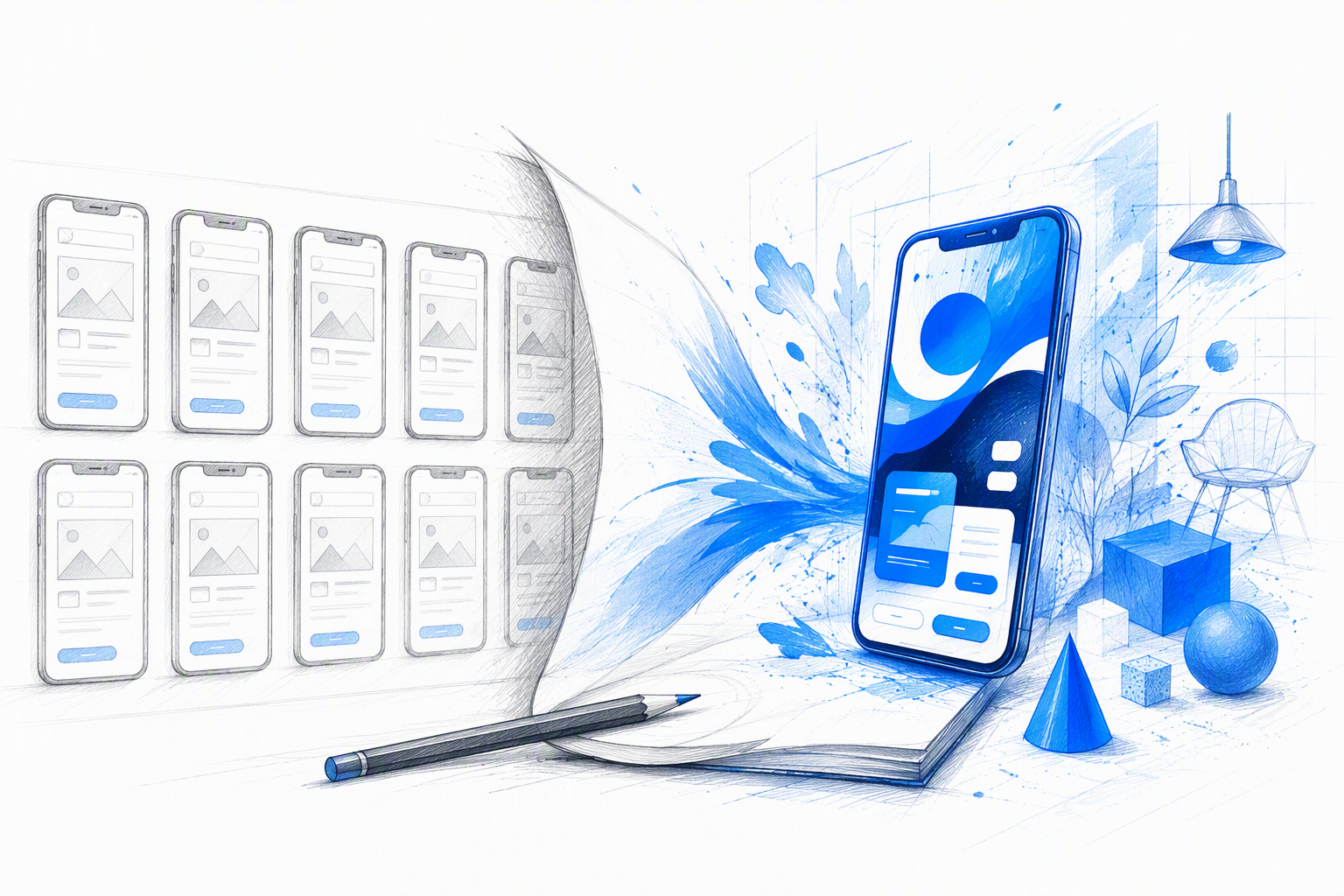
Interchangeable products often result from how decisions are made. A strong direction is presented, unfamiliar elements are removed, and the final interface becomes the option everyone has already seen.
We recommend evaluating directions against user value, brand fit, business relevance, accessibility, and feasibility. Trends can provide signals, but they should not control the product. Our review of UX and UI trends worth carrying forward separates durable principles from short-lived treatments.
When design systems create consistency—and sameness
Design systems support reuse and predictable behaviour. Trouble starts when a component library becomes the boundary of possible expression.
Keep accessibility behaviour, controls, states, and spacing logic stable. Adapt composition, typography, motion, illustration, content, and product-specific interactions where they add value.
How to protect a strong creative direction
Define the core idea behind the experience. It might be task-led decision-making, editorial storytelling, or progressive disclosure.
Document why key departures from convention exist. During implementation, review the product against those principles, not only against pixel measurements.
The building blocks of a distinctive interface
A distinctive interface comes from a connected system. Layout, type, motion, language, imagery, and controls should express the same point of view.
Typography and layout
Type scale, weight, contrast, rhythm, and whitespace establish hierarchy and personality. A layout can break a standard grid, but it must remain scannable and preserve its hierarchy across screen sizes.
Motion and interaction
Motion can explain state changes, progression, and spatial relationships. Micro-interactions can reinforce feedback and brand character, but they should respect reduced-motion preferences and never delay a task for theatrical effect.
Color, imagery, and visual texture
A controlled palette and consistent image direction can build recognition. Colour must still support contrast, readability, status communication, and interactive states. Coherence matters more than applying a fashionable effect.
Creative UX patterns that improve clarity and conversion
Creative UX can simplify an experience rather than make it more elaborate. We judge each idea by the problem it addresses.
Example: Reframing a generic SaaS dashboard
Problem: Equal visual weight makes the next useful action difficult to identify.
Decision: Replace a uniform card grid with a task-led hierarchy. Use scale and progressive disclosure to prioritise decisions and reveal supporting data when needed.
Outcome to evaluate: Task completion, feature adoption, and repeat use.
Example: Making onboarding explain itself
Problem: People encounter unfamiliar concepts before experiencing product value.
Decision: Introduce information when it becomes relevant. Use contextual copy and functional motion to clarify state changes.
Outcome to evaluate: Completion, activation, and abandonment points.
Example: Giving a conversion page a point of view
Problem: Polished sections do not form a persuasive sequence.
Decision: Build a deliberate narrative, use expressive typography to signal priority, and focus calls to action.
Outcome to evaluate: Comprehension, qualified leads, plan selection, or checkout completion.
Why UX, UI, and frontend execution belong together
Creative intent can disappear between discovery, design, and production. Our guide to freelance product design workflows explains how continuous ownership can carry a product idea through to release.
Static handoffs cannot fully represent responsive behaviour, interaction states, content variation, performance, or browser constraints.
Turning unconventional concepts into feasible experiences
We validate responsive layouts, edge cases, and performance early. Browser prototypes expose qualities such as scrolling, focus, input, and timing that static frames cannot show.
When technical constraints require changes, we preserve the central idea rather than reproducing every surface detail.
What strong design-to-development collaboration looks like
Teams should share intent and behaviour, not just screens. Reviews should cover breakpoints, input methods, loading conditions, error states, and content variations.
Our comparison of hybrid designers, agencies, and in-house UI UX teams can help teams assess the ownership model their product requires.
How to measure the impact of creative design
Define success before evaluating a direction. Relevant measures may include comprehension, task success, activation, adoption, retention, or conversion.
Pair behavioural data with interviews, usability observations, and support themes. We should not credit design alone when pricing, traffic, functionality, marketing, or engineering also changed.
Usability and comprehension signals
Useful signals include task completion, errors, time to locate information, confidence in the next action, and understanding of the product.
Product and business signals
Depending on the journey, teams may examine activation, feature adoption, return use, lead generation, plan selection, or checkout completion. Choose measures that match the original problem.
How to evaluate and hire a creative product designer
Finished visuals do not show whether a designer understood the problem, challenged assumptions, or handled constraints. Our guide to finding a product designer who can actually ship offers a practical evaluation framework.
What to look for in a creative design portfolio
Strong case studies show the problem, alternatives, reasoning, implementation constraints, and appropriate evidence. Our breakdown of genuinely hireable product designer portfolio examples helps hiring managers assess more than polished mockups.
Questions to ask a hybrid product designer
Ask which convention the designer challenged, how research influenced the direction, what changed in code, and how usability was protected. Strong candidates discuss trade-offs directly.
Is creative design a career?
Yes. Relevant paths include product design, UX, UI, interaction design, design engineering, creative development, and frontend-focused design. The amajaying product design and fullstack creative practice shows how strategy, interface craft, and implementation can work as one discipline.
Creative design FAQs
What is the difference between creativity and design?
Creativity generates possibilities. Design selects and develops a purposeful response within user, business, accessibility, and technical constraints.
Does creative design make a product less usable?
Not when it is handled well. We use novelty where it adds value and familiar patterns where they protect comprehension.
How do I make a design feel distinctive?
Build a coherent point of view across typography, layout, language, imagery, motion, and interaction. Avoid isolated decorative effects.
What jobs can I do with design technology?
Options include product designer, UX/UI designer, interaction designer, design engineer, frontend designer, creative developer, and design systems designer.
Is creative design the same as creative art, drawing, or clothing design?
No. They share creative principles, but digital product design must also address interaction, accessibility, responsive behaviour, feasibility, and user tasks.
FAQ
How do we create a creative design?
We define the user problem, identify the conventional response, challenge one useful assumption, prototype the alternative, and test comprehension and feasibility.
What careers are available in design?
Design careers span digital products, branding, graphics, motion, services, games, industrial products, interiors, fashion, packaging, publishing, and creative technology.
How can hiring managers identify genuine creative thinking?
Look for clear reasoning, alternatives, constraints, implementation decisions, and evidence. Ask candidates which convention they challenged and why.
Should creative product designers know frontend development?
They do not need to be production engineers, but frontend literacy helps them understand responsive behaviour, accessibility, performance, states, and browser constraints.
Create a product people remember
If your product works but still feels interchangeable, explore our product design practice and talk to us about creating a distinctive, usable, production-ready experience.