Product designer portfolio examples: how to spot work that is genuinely hireable
Learn the seven signals that separate polished portfolios from hireable work, so you can assess judgment, ownership, craft, and impact. Explore the examples.
By Ajay Khatri ·
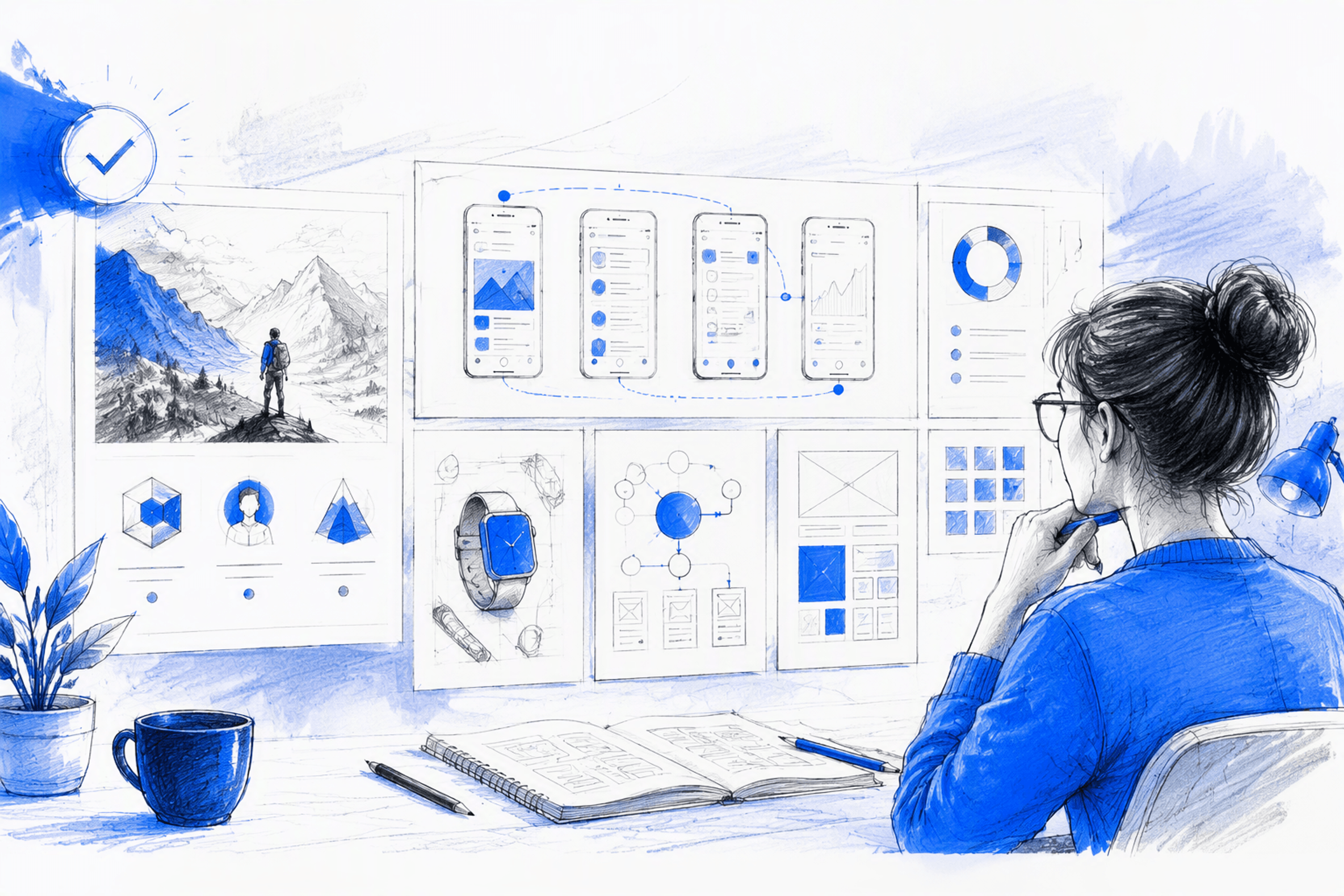
TL;DR
Many product designer portfolio examples prioritize polished screens over evidence of judgment. We recommend assessing seven signals: positioning, ownership, decisions, product depth, UI craft, execution, and credible impact. The strongest portfolios make a designer’s contribution and product thinking easy to verify.
Table of Contents
- TL;DR
- Product designer portfolio examples are useful when we know what to inspect
- A seven-signal scorecard for evaluating a product design portfolio
- Four product design portfolio archetypes and what they prove
- What separates a convincing case study from a project report
- How strong portfolios make individual ownership clear
- How to recognize credible impact without a revenue metric
- Senior product designer portfolios need a different standard
- Red flags to avoid copying from popular portfolio examples
- FAQ
- Evaluate the evidence behind the screens
Product designer portfolio examples are useful when we know what to inspect
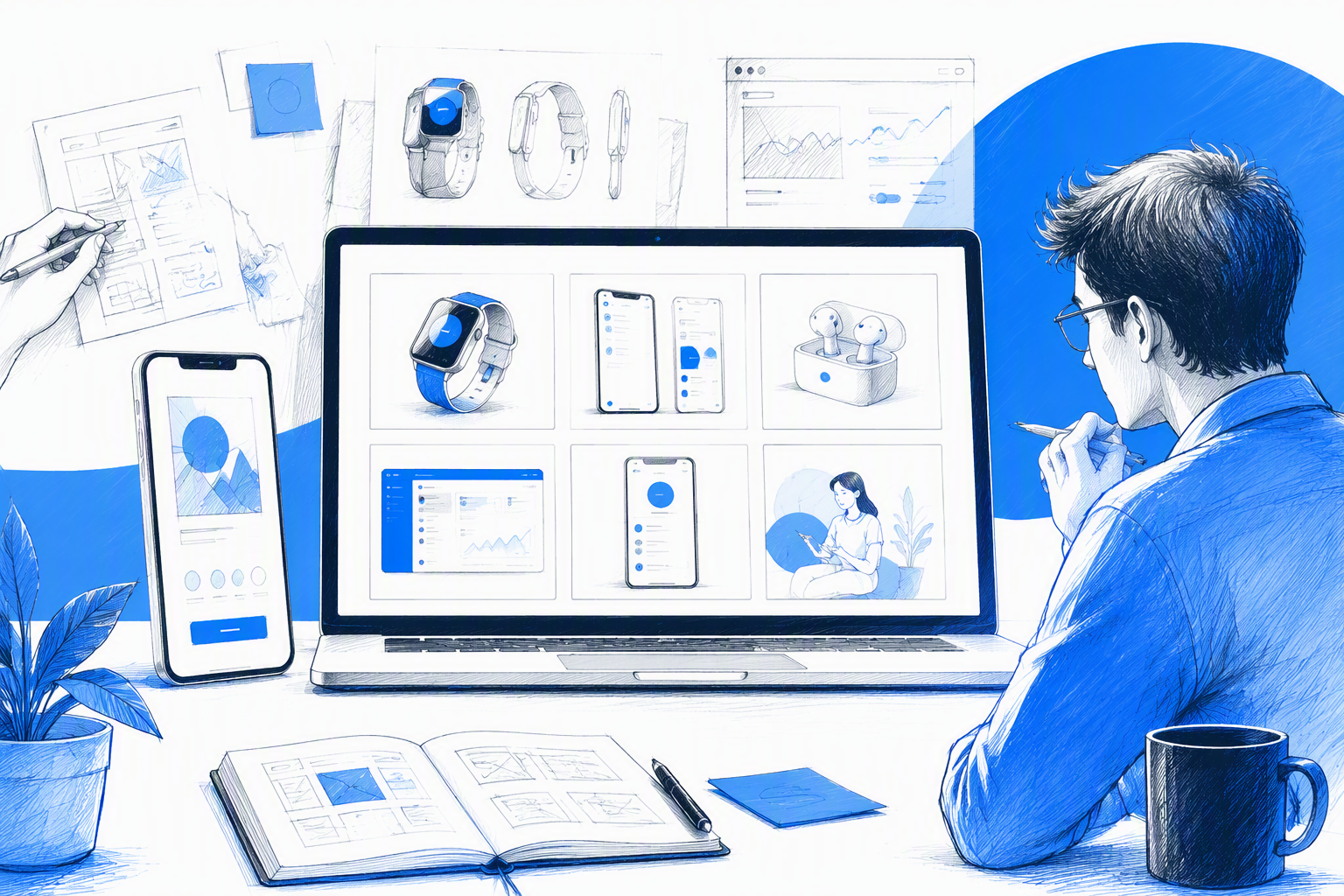
Portfolio galleries offer visual inspiration, but attractive screenshots rarely explain what a designer solved, owned, rejected, shipped, or improved.
We use product designer portfolio examples as evidence to assess, not styles to copy. For a page-level and case-study framework, see our practical product design portfolio sample.
The quick hiring-manager test
An initial scan should answer:
- What is the designer’s specialty and level?
- Which work is relevant to the role?
- What did the designer personally own?
- What changed because of that contribution?
- Do the visuals support those claims?
Each visual should demonstrate behavior, hierarchy, system thinking, implementation, or a meaningful design choice—not merely decorate the page.
Why another inspiration gallery would miss the point
Screenshots cannot reveal decision quality on their own. They do not show rejected alternatives, technical constraints, ownership boundaries, accessibility considerations, or the evidence behind the interface.
Our hiring-side portfolio evaluation guide applies this distinction across roles and portfolio formats.
A seven-signal scorecard for evaluating a product design portfolio
We assess each signal as absent, implied, or clearly evidenced. Role relevance matters more than a total score: a UI-focused role may emphasize craft, while a senior platform role may require deeper systems thinking and influence. Our product designer portfolio criteria can also support a formal review.
1. Positioning clarity
The designer’s specialty, level, and value should be immediately understandable. “Product designer focused on complex B2B workflows” sets a clearer expectation than broad claims about creating delightful experiences.
2. Ownership clarity
Strong portfolios separate personal responsibility from team output. Specific statements such as “I owned the interaction model” should be supported by relevant flows, prototypes, or decisions.
3. Decision quality
A useful case study explains why an important choice was made. Alternatives, constraints, and trade-offs reveal more judgment than a complete timeline of workshops.
4. Product depth
Depth appears in edge cases, usability, business context, and system behavior. Research artifacts belong when they influenced a decision; photographs of sticky notes prove little by themselves.
5. UI craft
Hierarchy, typography, spacing, interaction details, and consistency affect comprehension and trust. We inspect whether that craft extends to dense screens, responsive layouts, errors, and empty states. Our six-signal portfolio evaluation guide explains how presentation and evidence reinforce each other.
6. Execution evidence
Responsive behavior, prototypes, implementation notes, or frontend work can show whether an idea survives beyond static mockups. Our guide to finding a product designer who can deliver buildable work covers implementation fluency in more detail.
7. Credible impact
Valid outcomes may include clearer task completion, fewer usability problems, successful implementation, stakeholder adoption, or improved consistency. We prefer qualified evidence over unsupported revenue or conversion claims.
Four product design portfolio archetypes and what they prove
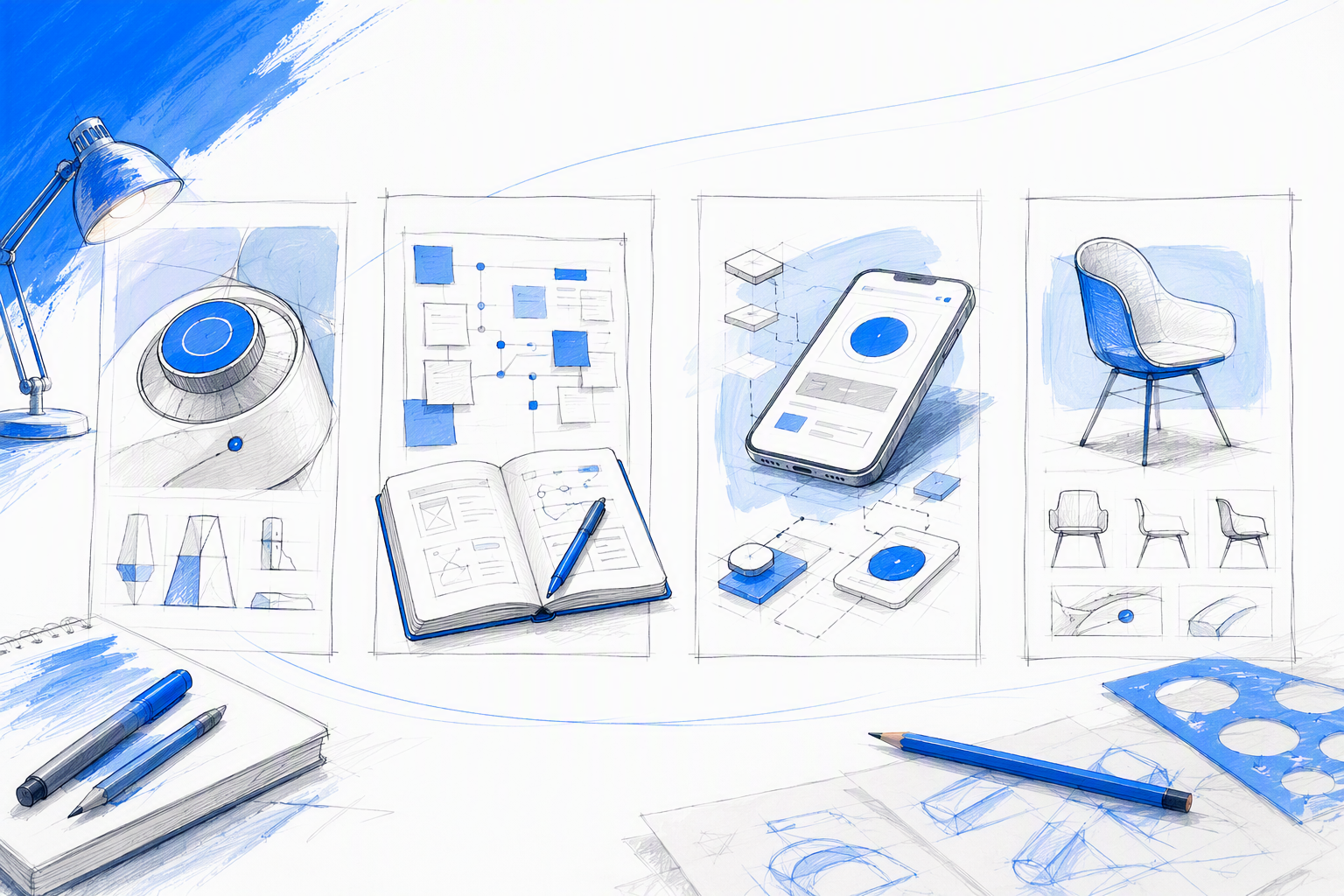
Recurring portfolio types prove different strengths. For another comparison lens, see our guide to product design examples of portfolio work.
The polished UI showcase
This format demonstrates visual craft, interaction quality, consistency, and taste. Its weakness appears when device mockups replace context. Adding the problem, key states, constraints, and design rationale makes the work more credible.
The decision-led case study
This archetype focuses on a small number of consequential choices. It gives enough context to explain why those decisions mattered without reproducing every activity or deliverable.
The shipped product and frontend portfolio
Live behavior, code, responsive details, and implementation notes provide strong execution evidence. Technical output still needs rationale: the portfolio should explain why the experience works as it does and how constraints shaped it.
The strategic senior portfolio
A strategic portfolio demonstrates prioritization, alignment, trade-offs, and influence. Workshop volume is not proof of leadership. We look for evidence that the designer reframed a problem, changed scope, introduced a system, or influenced direction.
What separates a convincing case study from a project report
A product designer portfolio case study should reveal judgment rather than record every activity. Our anatomy of an evidence-led case study shows how to connect claims with proof.
Look for a decision, not a deliverables timeline
A convincing narrative links a meaningful problem signal, a design choice, and an observable consequence. Research, wireframes, and workshops should support that chain rather than prove that a standard process happened.
Look for a real trade-off
Strong examples show what could not be optimized simultaneously: engineering effort and timing, familiarity and novelty, spatial constraints and accessibility, or user and business priorities. A genuine trade-off gives the final decision weight.
Look for evidence across the full product state
A polished happy path shows only the ideal scenario. Loading, empty, error, permission, validation, responsive, and recovery states reveal whether the interaction model is resilient.
Freshway App: read the work through one consequential decision
For Freshway App, the story should start with a specific grocery-browsing problem. The case study can then show the chosen intervention, an alternative, the relevant constraint, and how the final interface made browsing clearer.
How strong portfolios make individual ownership clear
Phrases such as “we redesigned the experience” or “I led UX” are too broad. Ownership can include decisions, artifacts, facilitation, implementation support, and influence without implying sole authorship.
Use contribution labels that can be verified
Useful labels include:
- “I owned the interaction model.”
- “I partnered with research on usability testing.”
- “I created and validated the responsive prototype.”
- “I supported frontend QA before release.”
Each label should match visible evidence.
Separate personal decisions from team outcomes
Strong case studies credit research, engineering, content, analytics, and business partners while identifying the designer’s own recommendations and execution. In our experience, clear collaboration makes an ownership claim more credible.
For senior work, show influence rather than claiming everything
Senior ownership may involve reframing scope, aligning stakeholders, mentoring contributors, or establishing standards. “Led the team” is a claim; showing what became aligned and how it changed is evidence.
How to recognize credible impact without a revenue metric
Not every project produces a reliable commercial result. We recommend matching each claim to the evidence available.
Behavioral and usability evidence
Relevant signals include observed errors, navigation problems, task completion, comprehension, or abandonment during testing. Where possible, the case study should explain the setting and limitations. A positive usability session does not establish market-wide impact.
Operational and implementation evidence
Impact can also appear through reusable components, fewer inconsistencies, clearer handoff, or successful release adoption. “Created a design system” becomes meaningful when the portfolio shows what it made more consistent or buildable.
Qualitative evidence with honest boundaries
User feedback, stakeholder acceptance, launch validation, and engineering confidence can be useful qualitative signals. Bounded language—such as “feedback indicated clearer comprehension”—is more credible than a universal claim.
Senior product designer portfolios need a different standard
Seniority appears through scope and influence, not longer case studies. We expect experienced designers to connect strategy, execution, organizational constraints, and outcomes.
Strategy connected to execution
Strategic language should lead to a concrete interface, system, priority, or shipped behavior. Without that connection, strategy feels abstract and screens appear merely tactical.
Trade-offs across teams and constraints
Senior examples should show how the designer balanced user needs, technical feasibility, timing, evidence, and organizational realities. Identifying what was deprioritized—and why—reveals decision maturity.
Multiplying impact
Systems, standards, mentorship, alignment practices, and reusable patterns can improve work beyond one release. The portfolio should identify who used them and what became easier, faster, or more consistent.
Red flags to avoid copying from popular portfolio examples
Visual popularity does not establish hiring effectiveness. We use the following warning signs to separate presentation trends from credible evidence.
Process diagrams without consequential decisions
A familiar process diagram does not prove project-specific reasoning. Replace it with a problem signal, a decision, the underlying trade-off, and the resulting change.
Repeated mockups without new evidence
Every screen should reveal something new: behavior, responsiveness, hierarchy, state management, accessibility, or system consistency. Repeated device frames add length, not proof.
Vague roles and unsupported outcomes
“Led the redesign” needs a defined scope. “Increased engagement” needs a source, timeframe, measurement, and credible attribution. Precise ownership and bounded outcomes build more trust.
Excessive confidentiality barriers
Password protection may be necessary, but it creates friction. When possible, a sanitized case study can preserve the problem, reasoning, ownership, and outcome without exposing confidential information.
Generic AI-written storytelling
AI can organize notes, shorten copy, and proofread. It cannot invent research, rationale, contributions, or results. If a case study could describe any project, it has lost the detail needed for assessment.
FAQ
What makes a product design portfolio strong?
A strong portfolio makes positioning, ownership, decisions, execution, and impact easy to verify. Visual polish helps when it supports credible product evidence.
Can ChatGPT make a product design portfolio?
It can help structure material and tighten copy, but it cannot supply authentic decisions, research, contributions, or outcomes. Every statement must remain faithful to the actual project.
What should a product design portfolio include?
We recommend clear positioning, relevant projects, role context, consequential decisions, supporting artifacts, credible outcomes, and a direct contact path.
Should a portfolio be a website or PDF?
A website can reduce access friction and demonstrate responsive or interaction craft. A PDF can work for controlled applications or presentations. The stronger format is the one that makes relevant evidence easy to scan.
Evaluate the evidence behind the screens
Use our scorecard to separate polished presentation from credible product work. If your team needs UX thinking, UI craft, and implementation awareness in one practice, explore our product design and full-stack creative work and start a focused conversation.