Design studio in Bangalore for distinctive digital products
Create coherent, distinctive digital products with a Bangalore team skilled in UX, UI, and frontend-aware execution. Explore Amajaying's design approach.
By Ajay Khatri ·
TL;DR
Amajaying is an independent digital product design studio in Bangalore focused on UX, UI, and frontend-aware execution. We help founders and product teams clarify complex journeys, create distinctive interfaces, and prepare designs for real implementation. Our approach connects product thinking, visual craft, and build support, reducing the gaps that often appear between an approved design and the shipped experience.
Table of contents
- TL;DR
- Table of contents
- A Bangalore design studio for distinctive digital products
- What this digital product design studio does
- Why a hybrid UX, UI, and frontend approach works better
- Independent product designer vs design studio vs agency
- Does your product need a redesign or targeted UX improvements?
- Distinctive UI without sacrificing usability
- Reusable foundations before a heavyweight design system
- How we work with founders, product teams, and engineers
- How to evaluate a design studio before hiring
- FAQ
- Discuss your product challenge
A Bangalore design studio for distinctive digital products
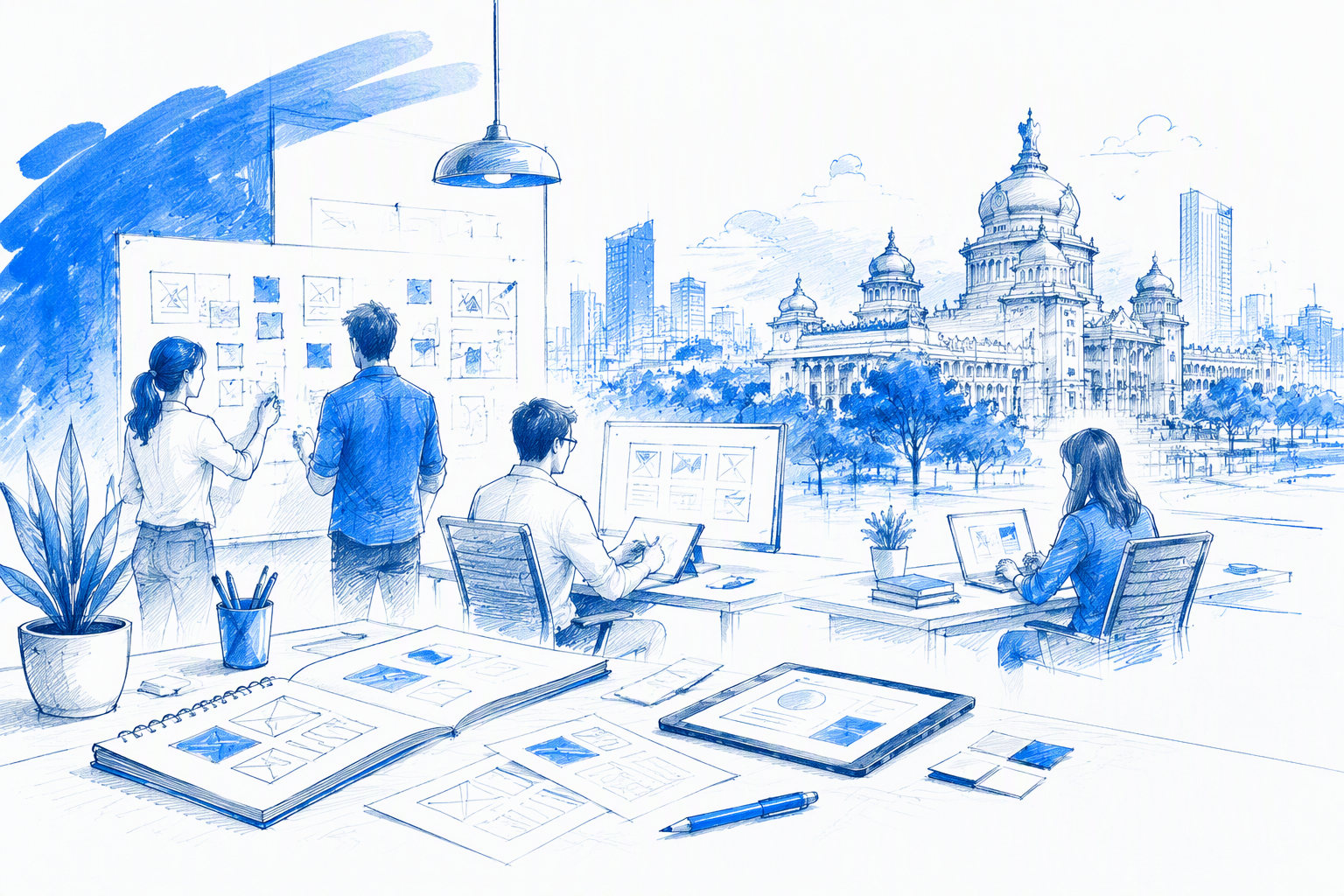
A search for a design studio often brings up interior, fashion, or architectural practices. Amajaying focuses on digital products. We work across UX strategy, interface design, interaction behaviour, and frontend-aware execution.
Many product teams do not need a large agency. They need an experienced partner who can understand the problem, challenge assumptions, shape a clear interface, and anticipate what will happen when engineers build it.
We work directly with founders and product teams, without unnecessary account-management layers. Rather than accepting a brief and returning later with polished screens, we make decisions visible and involve product and engineering partners throughout the process.
One partner from product thinking to execution
Continuity keeps the original product intent intact. The same design perspective can guide early framing, user flows, visual direction, responsive behaviour, and implementation support.
That does not replace product managers or engineers. It creates a closer working relationship in which questions can be resolved while the design is still flexible. Our product design and full-stack creative practice reflects this connected approach.
What this digital product design studio does
We shape each engagement around the product problem rather than a standard list of deliverables. A project may focus on one difficult journey, a new visual direction, a mature product redesign, or an experience being created from the ground up.
Our scope-first guide to UI and UX design services explains how clear boundaries and priorities lead to more useful work.
UX and product thinking
UX work may include:
- Product discovery and brief refinement
- User journeys and information architecture
- Task flows, wireframes, and prototypes
- Assumption mapping and prioritisation
- Validation planning and success criteria
Early investigation helps us avoid polishing the wrong solution. An onboarding problem, for example, may come from unclear language, an unnecessary step, or weak feedback rather than the overall visual design.
UI and interaction design
UI design turns product logic into a clear, recognisable experience. We may cover responsive layouts, typography, visual direction, interaction states, accessibility considerations, and high-fidelity prototypes.
Visual character should not be decoration added at the end. Hierarchy, colour, motion, and language can support comprehension while giving the product a coherent identity.
Frontend-aware design support
Real products contain long content, small screens, loading states, errors, empty states, and technical constraints. We consider these conditions before engineers have to interpret idealised mockups.
Support may include implementation guidance, component behaviour, design QA, or frontend work, depending on the agreed scope. Our guide to build-ready product design deliverables outlines the differences.
Why a hybrid UX, UI, and frontend approach works better
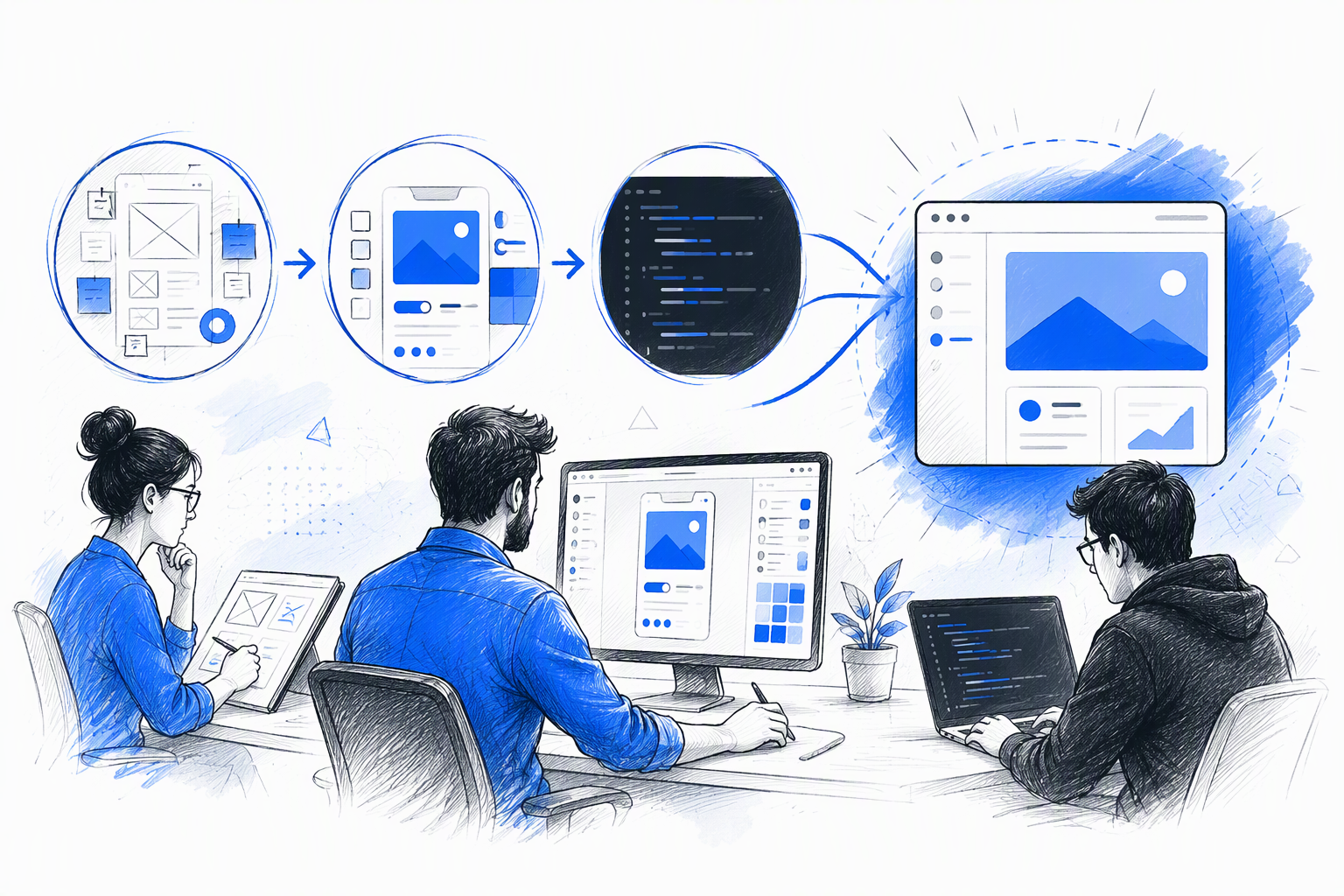
An approved interface can lose clarity during implementation. Missing states, vague component rules, and unexplained responsive behaviour leave engineers making design decisions late in the process.
Our hybrid approach treats end-to-end work as continuity of thinking. UX, UI, and build considerations inform one another instead of moving through isolated stages.
Fewer handoffs, less lost in translation
Separating research, UX, UI, account management, and development can create repeated transfers of context. A connected process shortens that distance while respecting each discipline’s expertise.
Direct collaboration also helps us resolve constraints and edge cases before they become rework.
Design decisions grounded in the real build
Build-ready design should account for:
- Fluid layouts and breakpoints
- Empty, loading, success, and error states
- Variable content and localisation
- Focus behaviour and accessibility
- Reusable component logic
- Technical limitations and trade-offs
Our end-to-end UI UX design service workflow shows how we connect product goals, design decisions, and production support.
Independent product designer vs design studio vs agency
The right model depends on the work. An independent senior-led practice offers direct access and continuity. A larger studio may offer broader specialist coverage, while an agency can provide capacity across parallel workstreams.
Our comparison of a hybrid designer, agency, and in-house team helps teams assess ownership, capacity, and collaboration rather than choosing by reputation alone.
Choose an independent practice when
An independent partner can suit teams that value:
- Direct senior involvement
- Fast, visible feedback
- One owner connecting UX and UI
- Close product and engineering collaboration
- Attention to distinctiveness and implementation
This model is especially useful when priorities are changing and the person framing the problem must remain accountable for the resulting decisions.
Choose a larger team when
A larger studio or agency may be more suitable for extensive research operations, several simultaneous product streams, or high-volume work across channels and markets.
No independent practice should pretend to offer unlimited capacity. The structure should match the scope, required pace, and resources already available within the client team.
Does your product need a redesign or targeted UX improvements?
A dated or inconsistent interface does not automatically require a complete redesign. Usability, conversion, visual identity, implementation quality, and consistency are separate problems.
We first identify where the friction occurs and what evidence supports it. That assessment helps us choose between a focused improvement and broader change.
Signals a focused improvement may be enough
A targeted engagement may work when:
- One important journey creates most of the friction
- Selected screens need clearer hierarchy or feedback
- A release needs a stronger visual direction
- Repeated patterns lack shared foundations
- Implementation is inconsistent despite sound product logic
A focused scope can improve the problem area without destabilising the wider experience.
Signals a broader redesign may be justified
A broader redesign may be appropriate when navigation no longer reflects the product, core journeys conflict, or legacy decisions make features difficult to extend.
It can also make sense when the experience is hard to use, difficult to maintain, and visually indistinct. We recommend assessing structural and local problems separately before committing to a full redesign.
Distinctive UI without sacrificing usability
A recognisable interface can help a product stand apart, but distinctiveness does not require visual noise. We use hierarchy, typography, colour, motion, interaction, and language to create a point of view that fits the audience and product position.
When a product experience feels too generic
Common signs include:
- Default component patterns dominate the interface
- A logo change could make the product resemble a competitor
- Functional screens do not communicate product value
- Visual rhythm and tone vary between journeys
- Brand character appears in marketing but not in the product
We avoid applying a fashionable signature style. Creative choices should emerge from the product’s purpose, users, category, and technical context.
Recognition is more than cosmetic branding
Consistent cues can also support orientation. Colour can communicate status, spacing can show relationships, motion can explain change, and concise language can clarify the next action.
Aesthetic differentiation cannot compensate for a weak product. It works best when it strengthens an experience that already addresses a meaningful need.
Reusable foundations before a heavyweight design system
Not every product needs a comprehensive design system immediately. An evolving team may benefit more from clear foundations and a dependable set of reusable components than from extensive documentation for patterns it does not yet use.
Start with the patterns the product actually uses
We usually begin with practical foundations:
- Typography, colour, and spacing
- Layout rules
- Buttons, inputs, and controls
- Navigation and feedback patterns
- Loading, empty, success, and error states
- Common content and data components
This provides enough structure to ship consistently without creating a speculative library.
Scale the system with the product
As the product and team grow, these foundations can develop into a formal system with documentation, ownership, contribution rules, and governance.
Design and engineering should agree on naming, variants, states, and behaviour. A polished but disconnected UI inventory is not a functioning design system.
How we work with founders, product teams, and engineers
Our process is iterative: align, investigate, frame, prototype, refine, support the build, and evaluate. These activities may overlap because product work rarely progresses through perfectly isolated phases.
We favour direct communication and visible work in progress. Our freelance product design workflow for shipped experiences explains how we connect problem framing with implementation.
A useful product design brief
A practical brief covers:
- The business goal and target users
- Available evidence and known pain points
- Product and technical context
- Constraints, dependencies, and timing
- Stakeholders and decision-makers
- A clear definition of success
The brief does not need to answer everything. Refining the problem is part of our work, but ownership of feedback and final decisions should be clear.
Collaboration from Bangalore
As a Bangalore-based practice, we can collaborate with local, remote, and hybrid product teams. Before kickoff, we agree on communication channels, availability, review points, and any in-person expectations.
The aim is a predictable working rhythm, not more meetings.
From kickoff to shipped experience
Useful checkpoints include early-flow reviews, prototype feedback, visual-direction approval, implementation clarification, and design QA.
We bring product and engineering feedback into the process before major choices become costly to change. Our guide on how to find a product designer who can actually ship can help teams assess execution capability alongside visual craft.
How to evaluate a design studio before hiring
A polished portfolio demonstrates craft, but not necessarily product judgement. We recommend examining how a studio defines problems, uses evidence, handles constraints, makes trade-offs, and supports implementation.
A practical buyer’s checklist for UIUX design services can make comparisons more consistent.
Look beyond polished screens
For each case study, ask:
- What user or business problem changed?
- What evidence informed the direction?
- Which constraints shaped the result?
- What did the designer personally own?
- How were different devices and states handled?
- Did the work reach implementation?
Strong case studies explain decisions and distinguish individual ownership from the wider team’s contribution.
Questions to ask before starting
Clarify who will do the work, how assumptions will be tested, how changes are documented, and how design and engineering will collaborate. The proposal should also explain inclusions, exclusions, dependencies, and how progress will be assessed.
Measure impact after launch
Measures should match the original problem and may include task completion, activation, conversion, support requests, retention signals, delivery speed, or consistency.
We combine relevant measures with user feedback and team observations. Design is only one influence on product performance, so results should be interpreted in context.
FAQ
What does a digital product design studio do?
A digital product design studio improves how software works, feels, and behaves. Its work may include discovery, UX flows, interface design, prototypes, reusable components, implementation guidance, and design QA.
When should we hire an independent product designer instead of an agency?
An independent designer can suit projects requiring direct senior involvement and continuity across UX and UI. An agency may be more suitable when several large workstreams need to run at once.
Does frontend-aware design include development?
Not automatically. It means our decisions consider responsive behaviour, component logic, accessibility, content changes, states, and technical constraints. Any production code or implementation support should be defined in the proposal.
Do we need a complete product redesign?
Not necessarily. A focused improvement may be enough when one journey or feature creates most of the friction. Broader redesigns suit products with structural problems across navigation, core journeys, and interaction patterns.
How should we evaluate a design studio portfolio?
Look for problem definition, evidence, constraints, trade-offs, responsive behaviour, edge cases, and implementation outcomes. Confirm what the designer owned rather than judging screens alone.
Can a Bangalore design studio work with remote teams?
Yes. We recommend agreeing on decision-makers, communication channels, review points, availability, and feedback responsibilities before work begins.
Discuss your product challenge
If the product feels generic, fragmented, or difficult to ship consistently, explore Amajaying’s product design work and contact us to define the smallest useful scope for improving it.