UI UX design service: an end-to-end guide from product goal to production
Discover how an end-to-end UI UX design service aligns strategy, user flows, interfaces, and engineering to improve product outcomes. Explore the guide.
By Ajay Khatri ·
TL;DR
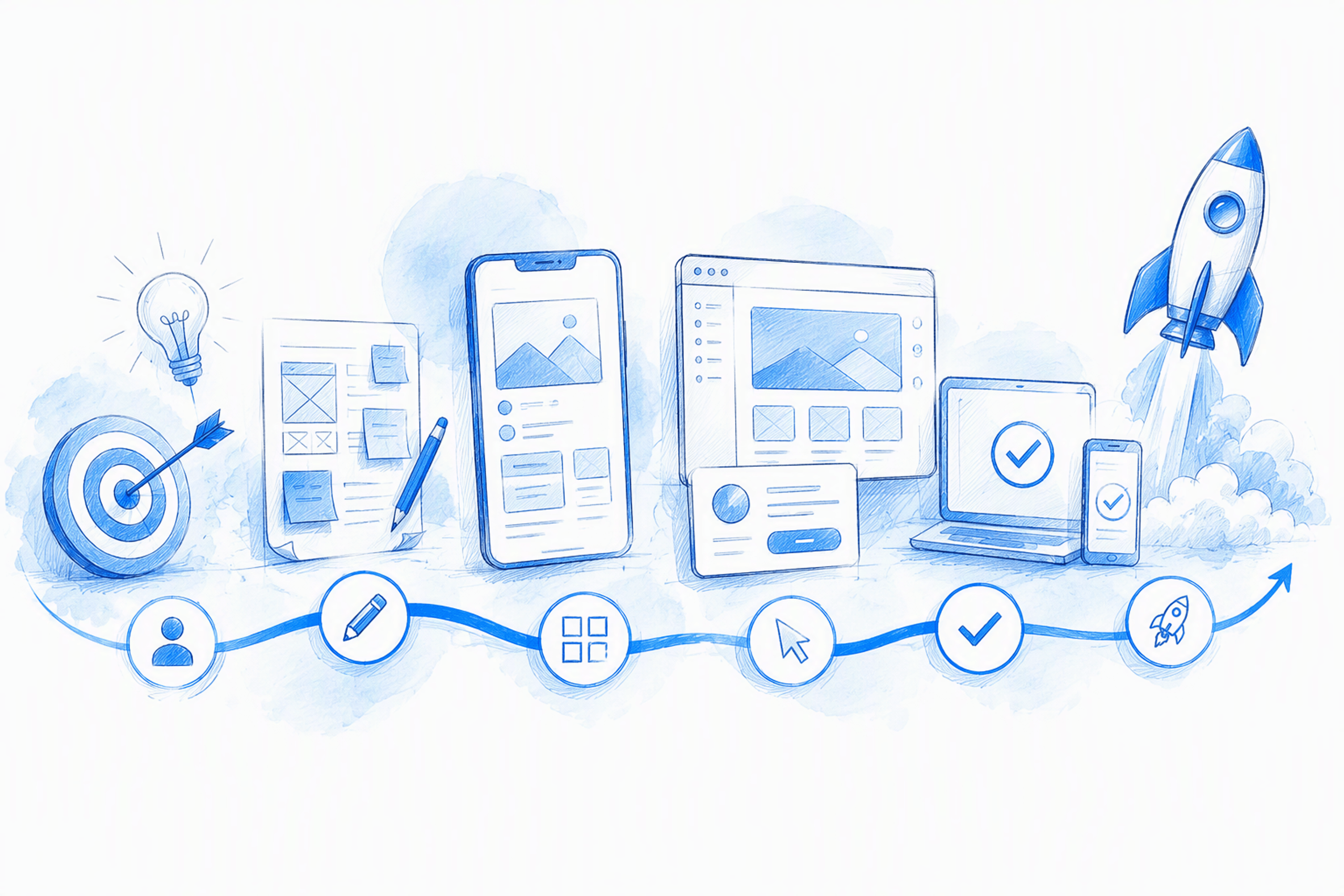
A strong UI UX design service connects product strategy, user flows, interface design, and frontend execution. The goal is not a polished Figma file but a coherent, buildable product experience. We recommend choosing the smallest engagement that addresses the product’s main risk while keeping design and engineering aligned.
Table of contents
- TL;DR
- Table of contents
- What an end-to-end UI UX design service actually includes
- Start with the product outcome, not a linear design ritual
- Deliverables by stage: what you should receive and own
- Buildability is part of the design service
- Choose the engagement model that matches the product risk
- Independent designer vs agency vs in-house hire
- What affects UI UX design service pricing and timelines
- How to select the right service without repeating a portfolio review
- FAQ
- Turn the product problem into a buildable experience
What an end-to-end UI UX design service actually includes
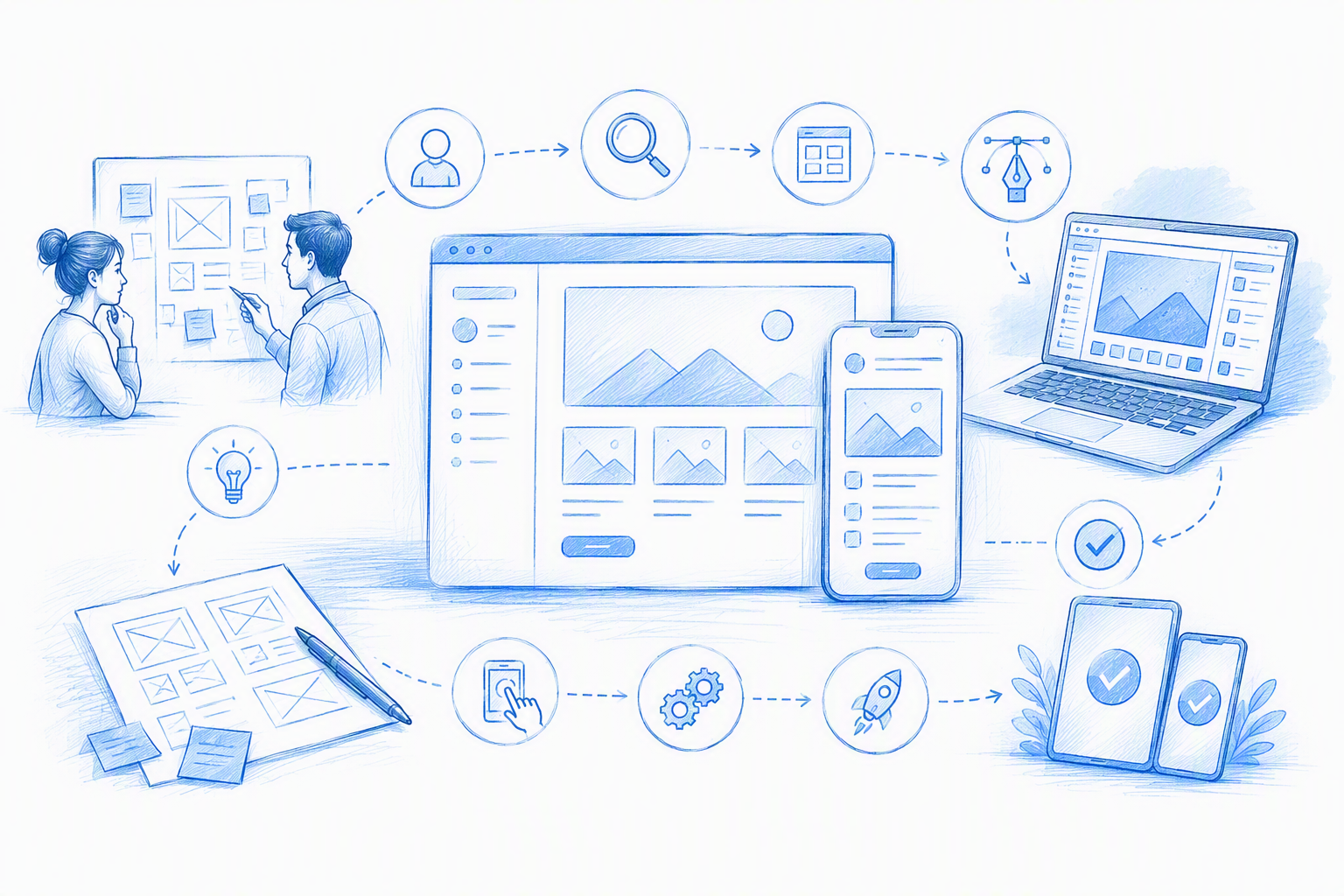
When UX, UI, and development are separated by rigid handoffs, engineers often have to reconstruct the intended experience from incomplete specifications.
We take a more integrated approach. A good UI UX design service should connect product reasoning, visual craft, and implementation. Depending on the problem, that can mean improving onboarding, task completion, repeat use, product comprehension, or brand credibility.
The scope may include discovery, user flows, interface design, prototyping, design systems, validation, implementation support, and post-release iteration. Not every project needs every activity. Our UIUX design services capability checklist helps teams identify which capabilities their product requires.
UI, UX, and product design are connected—not interchangeable
UX covers behaviour, structure, and how people complete tasks. UI covers visual hierarchy, presentation, interaction feedback, and interface details.
Product design connects both to commercial goals and technical constraints. A request for “just UI” may reveal a structural problem: better typography cannot fix a confusing flow. We examine the experience first, then use visual design to make it clear and distinctive.
The outcome is not a Figma file
Figma is a working environment, not the final product. The outcome is a responsive, accessible interface that retains its logic and character in production.
That requires attention to mobile behaviour, loading and error states, permissions, focus treatment, component variants, and real content. At amajaying.com, we believe design should make implementation easier, not simply make design reviews look polished.
Start with the product outcome, not a linear design ritual
A project does not always need a long sequence of discovery, wireframes, testing, and handoff. We scale the process to the risk and cost of getting a decision wrong.
Focused discovery
Discovery should clarify the business goal, target users, available evidence, constraints, and riskiest assumptions. We focus on the questions that must be answered before interface work can progress, rather than producing research documentation for its own sake.
Prototype before over-documenting
A realistic prototype makes product logic tangible. Teams can inspect key interactions, identify missing states, and gather focused feedback before investing in production code.
Research depth should match the risk. A novel or consequential workflow may need deeper validation than a familiar, low-risk interaction. This principle also shapes our freelance product design workflows that move from problems to shipped experiences.
Define success before polishing screens
We recommend agreeing on success signals before detailed visual work begins. Depending on the project, those signals may concern onboarding completion, task success, conversion, repeat use, support demand, or customer comprehension.
Without that shared definition, reviews can collapse into personal preference.
Deliverables by stage: what you should receive and own
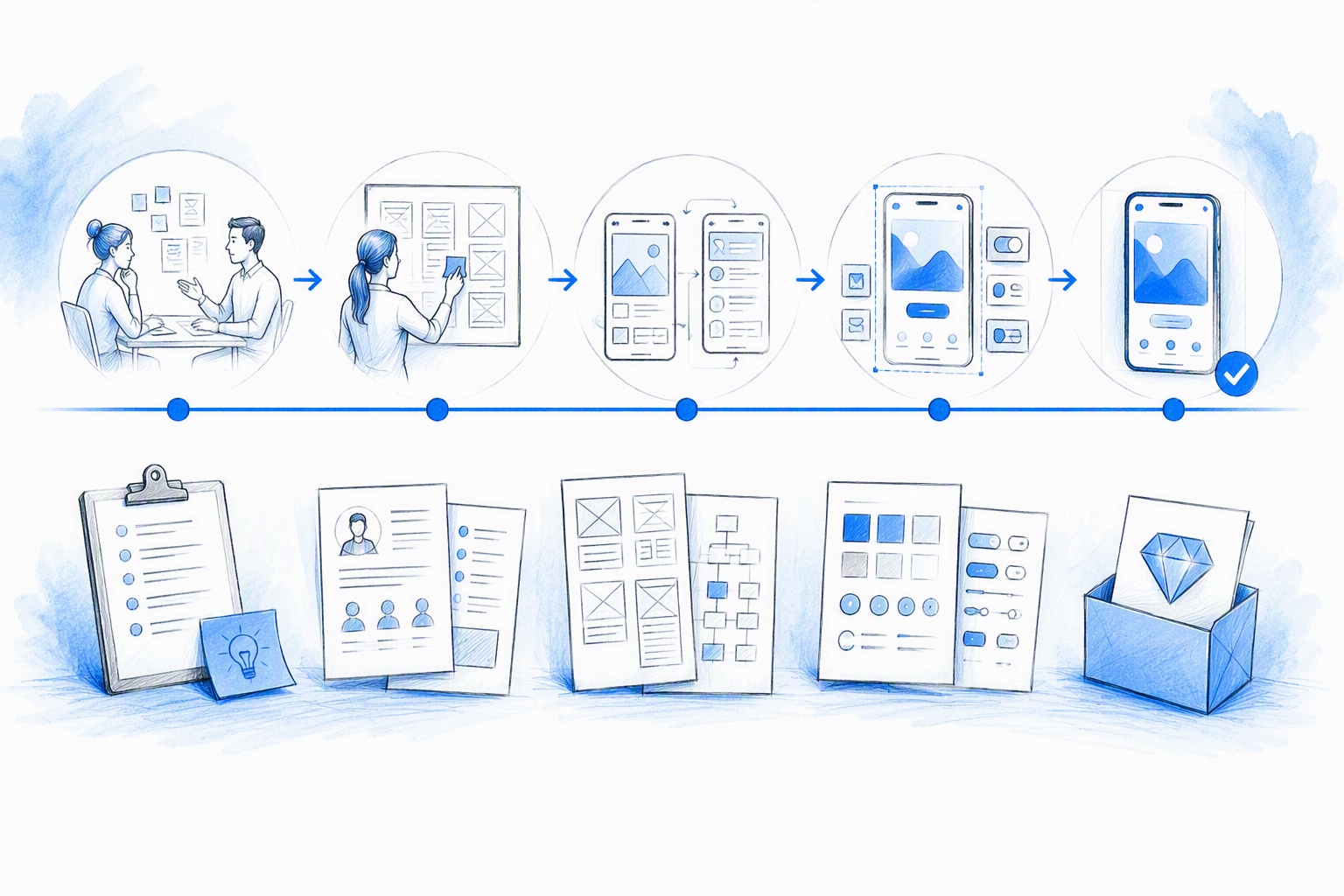
UI UX design deliverables should support decisions, implementation, and learning. Before work starts, both sides should confirm source-file access, ownership, usage rights, component documentation, and licensing constraints.
Direction and structure
Early deliverables may include a product brief, assumptions, user journeys, information architecture, prioritised flows, success criteria, and relevant research notes. Each artefact should reduce uncertainty or guide a decision.
Interaction and interface
This stage may include wireframes, responsive layouts, high-fidelity screens, interactive prototypes, and component states. Wireframes are useful when a team needs to examine structure without visual distraction, but they are not mandatory for every screen.
Implementation and continuity
Implementation-ready deliverables can include tokens, reusable components, responsive rules, interaction notes, production assets, accessibility guidance, state handling, and frontend review.
We also document important decisions where useful. That context helps engineers make technical trade-offs without losing the reasoning behind the design.
Buildability is part of the design service
Implementation quality is a design concern. If hierarchy, responsive behaviour, or interaction feedback disappears during development, the intended experience has not been delivered.
Design and engineering collaboration exposes constraints early, allowing us to adapt deliberately instead of discovering problems at the end. Our guide to UI/UX design services that survive frontend execution explains this standard in more detail.
What implementation-ready design specifies
Depending on the product, specifications should address:
- Responsive behaviour
- Component variants
- Loading, empty, error, and success states
- Roles and permissions
- Content limits and overflow
- Disabled actions
- Keyboard navigation and focus behaviour
- Real data and edge cases
An attractive desktop screen is not enough if the real product must support long labels, missing records, restricted roles, or changing data.
Design systems that reduce rework
A design system should reduce inconsistency and repeated decisions. It should not become a separate project that delays the product.
We create reusable patterns at the level the product justifies. A focused MVP may need a compact component foundation; a mature product may need broader coverage and governance. Figma and frontend components should evolve together.
Quality control after handoff
We recommend reviewing the actual build across relevant screen sizes, interactions, and states. Screenshots cannot reveal keyboard behaviour, overflow, focus order, transitions, or responsive failures.
UX/UI design services without the development handoff gap make this review part of delivery rather than optional cleanup.
Choose the engagement model that matches the product risk
The right engagement is the smallest one capable of resolving the main uncertainty. A full redesign is excessive when one activation path is failing, while a short visual sprint cannot repair a broken product structure.
Product sprint
A product sprint suits a team that needs to clarify an idea, risky workflow, or strategic direction. It can produce a focused problem definition, prioritised flow, prototype, interface direction, and recommended next step.
MVP design
An MVP UI UX design service turns an early concept or rough build into a coherent first release. We focus on the core journey, priority screens, realistic states, responsive behaviour, reusable components, and implementation guidance.
Product or interface redesign
A redesign fits a working product whose usability, positioning, or interface no longer supports its goals. We preserve successful behaviour where possible, then repair confusing structures, competing actions, weak hierarchy, and inconsistent patterns.
Embedded design and design-to-code support
Embedded support gives teams ongoing design ownership without immediately adding a permanent role. It can cover feature iteration, system development, implementation review, experiments, and selected frontend work.
A contract product designer engagement can provide this continuity while keeping responsibilities clear.
Independent designer vs agency vs in-house hire
The right model depends on scope, duration, specialist needs, parallel workload, and the level of day-to-day integration required.
When an independent product designer fits
An independent designer can work well when a team needs senior UX thinking, distinctive UI craft, and frontend awareness with direct communication. Founders and engineers can speak with the person making the decisions rather than routing feedback through several layers.
When an agency or in-house team may fit differently
An agency may suit a broad rollout that requires several specialist workstreams at once. A mature product with continuous demand may benefit from an internal team that can build long-term organisational knowledge.
Headcount alone does not determine quality or delivery risk.
Why Bangalore can work for local and global teams
A freelance UI UX designer in Bangalore can collaborate closely with local product and engineering teams while supporting remote organisations through agreed working hours.
We treat location as a practical consideration, not a substitute for product judgment, communication, craft, or accountability.
What affects UI UX design service pricing and timelines
Pricing depends on uncertainty, complexity, and responsibility—not only the number of screens. A credible estimate requires context about the product, users, platforms, technical environment, existing system, validation needs, and implementation support.
The biggest scope drivers
Common scope drivers include:
- Number and complexity of user journeys
- Roles, permissions, states, and integrations
- Platform and responsive requirements
- Research and validation depth
- Accessibility requirements
- Existing component maturity
- Frontend execution or review
- Whether the work starts from an idea or working product
Signs of scope creep
Scope changes when new users, features, platforms, integrations, or goals appear after approval. Those changes may be sensible, but they should be assessed as new work.
Repeated preference changes without new evidence can also disrupt delivery. Refinement improves an agreed direction; a new direction requires a scope discussion.
How to keep the engagement efficient
We recommend naming one decision owner, involving engineers early, providing timely access to evidence, and agreeing on a regular review cadence.
Milestones should correspond to decisions. Approve the critical flow before polishing every component, then inspect the implemented journey before expanding the system.
How to select the right service without repeating a portfolio review
A portfolio shows output, but it does not prove that a designer can connect business goals, user needs, technical constraints, and production quality.
Ask what success means, what is included, which decisions need validation, what engineering will receive, and who will review the shipped result.
For portfolio assessment, use our separate six-signal guide to evaluating the best product design portfolios.
A useful first brief
A practical brief includes product maturity, target users, known problems, business goals, constraints, desired launch window, engineering setup, and available analytics or feedback.
It does not need to prescribe the solution. Rough builds, unresolved questions, and incomplete requirements are valid starting points.
Red flags before work begins
Warning signs include:
- Screens promised before the user flow is understood
- Deliverables defined only by screen count
- Design and engineering isolated until handoff
- Important states excluded from scope
- No owner for implementation review
- Research ignored or prescribed without considering risk
The decision in one sentence
Choose the service that can maintain one coherent thread from the product problem and business goal to the shipped interface.
FAQ
What does a UI UX design service include?
It may include discovery, user flows, information architecture, interface design, prototyping, responsive layouts, component systems, validation, accessibility guidance, and implementation support. Scope should reflect the product’s maturity, risk, goals, and engineering setup.
How long does a UI UX design project take?
The timeline depends on workflow complexity, research depth, platforms, stakeholder availability, system maturity, and implementation involvement. We recommend clarifying those factors before setting a schedule.
Should UI UX design services include frontend development?
Not every engagement needs direct development, but every design service should account for frontend reality. Responsive behaviour, states, accessibility, content limits, and interaction logic must be practical to build.
Is an independent UI UX designer better than an agency?
Neither is always better. An independent designer may offer direct access and continuity, while an agency may provide more parallel capacity. The best option depends on scope, internal resources, specialist needs, and operating style.
How should a startup scope an MVP UI UX design service?
Start with the core user, primary problem, essential journey, desired business outcome, technical constraints, and launch assumptions. Include enough responsive and component planning to make the release coherent without designing a mature platform prematurely.
Turn the product problem into a buildable experience
Share your product stage, core problem, target outcome, launch window, and engineering setup with us. We’ll recommend the most suitable next step—whether that is a focused sprint, MVP design, redesign, embedded support, or design-to-code engagement.