UI UX designing services: hybrid designer vs agency vs in-house team
Compare hybrid designers, agencies, and in-house teams to choose UI UX support that solves user friction, speeds delivery, and fits your needs. Explore options.
By Ajay Khatri ·
TL;DR
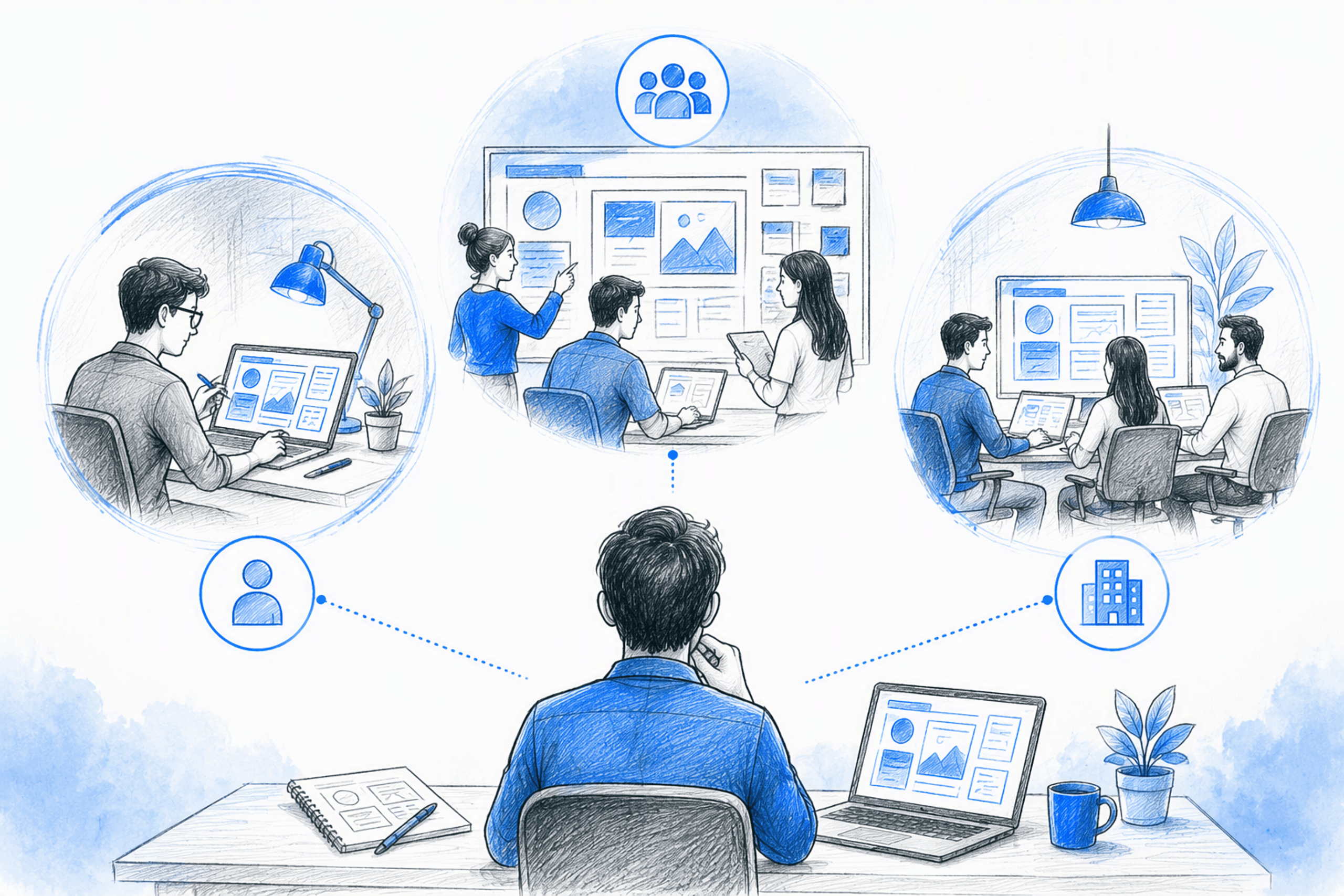
Hiring ui ux designing services should lead to more than a new colour palette and another Figma file. Strong work connects user friction, interface craft, business priorities, accessibility, and frontend constraints. We recommend choosing an operating model based on the problem, internal capabilities, urgency, and number of parallel workstreams—not the provider’s size or label.
Table of contents
- Before hiring UI/UX designing services, choose the right operating model
- Hybrid designer vs agency vs specialist vs in-house team
- The hidden cost of splitting UX, UI, and frontend ownership
- How to assess a UI/UX design portfolio beyond polished screens
- Match the engagement to the problem you actually have
- UI/UX design pricing in Bangalore: what changes the cost?
- Proof point: designing discovery and engagement for Hevo Blog UI
- Questions to ask before choosing a UI/UX service provider
- UI/UX services in 2026: AI changes the workflow, not accountability
- FAQ
- Choose an operating model built to ship
Before hiring UI/UX designing services, choose the right operating model
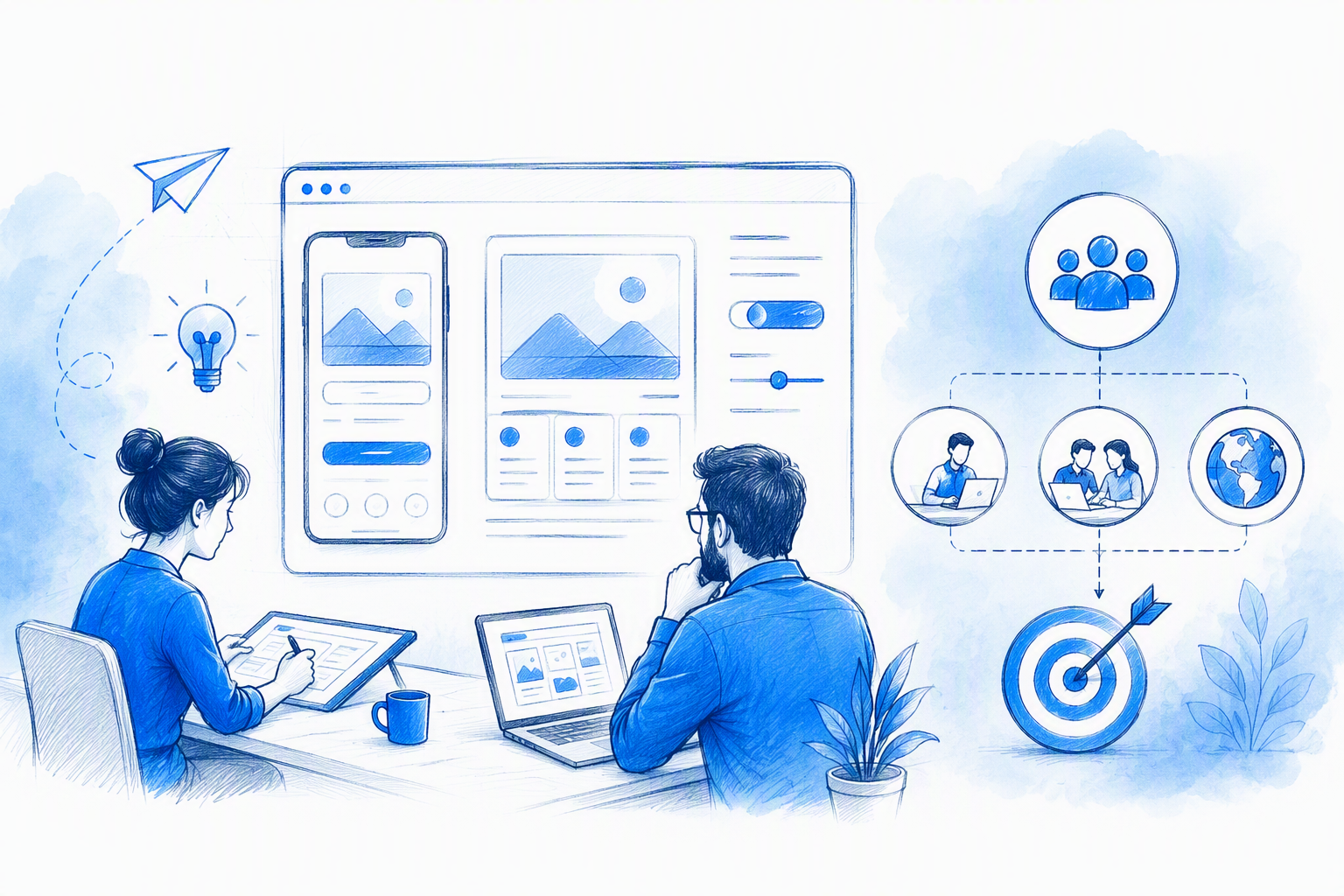
This is a provider-selection guide rather than another catalogue of wireframes, prototypes, and workshops. For a complete deliverable breakdown, see our guide to UI/UX designing services that do more than deliver Figma files.
The operating model affects decision speed, accountability, consistency, and what survives implementation. Common options include an independent hybrid designer, a design agency, a specialist freelancer, or an in-house hire.
Start with the problem, not the provider label
We begin by defining the immediate problem:
- Weak usability or confusing journeys
- Generic visual identity
- Inconsistent interaction patterns
- Poor discovery, conversion, or engagement
- Drift between design and development
A focused, high-impact journey may benefit from direct senior execution. A programme involving concurrent research, branding, content, motion, design, and development may require a larger team.
Hybrid designer vs agency vs specialist vs in-house team
Team size is not a reliable measure of design quality. We compare operating models by scope, internal capability, urgency, continuity, and the number of workstreams involved.
| Model | Accountability | Speed | Specialist depth | Continuity | Cost structure | Capacity | Frontend alignment |
|---|---|---|---|---|---|---|---|
| Hybrid designer | Direct and concentrated | Fast feedback | Broad product skills | High | Project, day rate, or retainer | Suited to focused work | Often strong |
| Agency | Distributed | Variable | Access to a broad team | Depends on staffing | Project or retainer | High | Depends on the team |
| Specialist freelancer | Clear within one discipline | Fast for narrow scopes | Deep specialist expertise | Medium | Day rate or project | Limited | Discipline-dependent |
| In-house hire | Embedded | Improves with context | Role-dependent | Very high | Salary and employment costs | Continuous | Strong with team access |
When an independent hybrid designer is the stronger fit
A hybrid designer suits teams seeking direct senior collaboration across UX reasoning, visual design, and frontend constraints. Fewer handoffs can shorten feedback loops and keep ownership clear.
We find this model useful for early-stage products, focused redesigns, and teams that need distinctive craft without agency layers. Our freelance product design workflow shows how we connect product problems to shipped experiences through one process.
When an agency or larger team may make sense
An agency can be the right choice when several substantial streams must run concurrently. Its main advantage is capacity, although that does not guarantee quality or continuity.
Before hiring, confirm who will perform the daily work. We recommend asking whether senior designers remain involved after the sales process or hand responsibility to another delivery team.
When a specialist or in-house hire is more appropriate
A specialist makes sense when the gap is isolated, such as research, illustration, motion, accessibility, or design systems. There is little value in paying for a full team when one capability is missing.
An in-house designer is usually better suited to continuous, context-heavy work that justifies a permanent role. Our guide for companies hiring product designers can help teams compare permanent and flexible capacity.
The hidden cost of splitting UX, UI, and frontend ownership
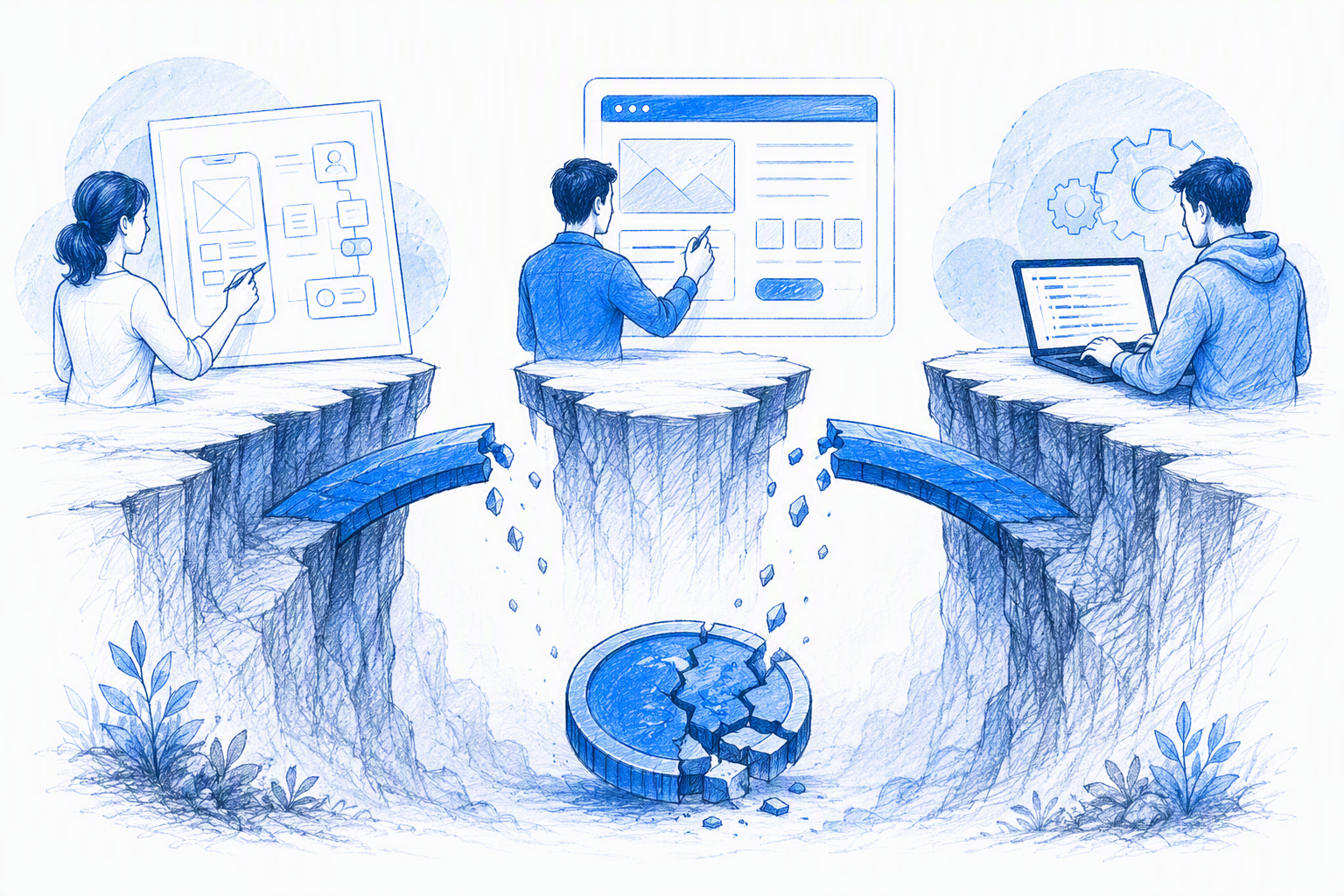
Separating UX, UI, and frontend work can create interpretation gaps, repeated meetings, and diluted reasoning. Each handoff risks detaching interface decisions from the original user or business problem.
A buildable interface must account for responsive behaviour, component states, accessibility, variable content, browser behaviour, and technical constraints. UI/UX design services that survive frontend execution should expose those considerations before development starts.
Hybrid ownership can reduce drift, but it does not mean one person should replace every specialist.
What design-to-development drift looks like
Common warning signs include:
- Missing mobile or intermediate-width layouts
- Components behaving differently across screens
- Layouts that only work with ideal-length content
- Undefined loading, error, empty, and success states
- Visual choices that create accessibility barriers
- Developers redesigning interactions during implementation
Polished desktop mockups can conceal these problems.
What implementation-aware design changes
Implementation-aware design tests decisions against real breakpoints, reusable patterns, technical limitations, and browser behaviour early. Feasibility becomes part of the design process instead of a late correction.
We also recommend developer clarification, implementation review, and refinement after handoff. That collaboration closes the UX/UI design handoff gap more effectively than annotations alone.
How to assess a UI/UX design portfolio beyond polished screens
Screenshot polish is supporting evidence, not proof of strong UX. A credible case study should explain the problem, user friction, constraints, alternatives, decisions, and shipped result.
Visual craft still matters, but it should support hierarchy, usability, responsiveness, accessibility, and product character.
Six signals of credible product design work
We use this scorecard:
- Clear problem framing and prioritisation
- Evidence of flows, edge cases, iteration, and trade-offs
- A visible connection between inputs and design decisions
- Responsive and accessible behaviour
- Implementation quality or shipped-product evidence
- Outcomes connected to the original problem
Our six-signal product design portfolio guide explains how we distinguish a persuasive case study from a polished gallery.
Questions to ask about a case study
Ask:
- What was difficult or ambiguous at the start?
- Which option was rejected, and why?
- What changed after feedback or validation?
- How closely did the shipped product match the design?
Strong answers reveal judgment and trade-offs. Weak answers rely on process diagrams and unexplained screens.
Match the engagement to the problem you actually have
A full redesign is not always the answer. Focused scopes often create clearer timelines, responsibilities, costs, and success criteria.
Before buying a broad package, use a 14-capability UIUX design services checklist to identify what the problem actually requires.
Choose a focused UX audit
An audit fits a functioning product with underperforming journeys or unclear priorities. Inputs may include analytics, support issues, stakeholder knowledge, heuristic review, and targeted usability checks.
We do not recommend research for its own sake. It should reduce uncertainty around a meaningful decision.
Choose a feature or journey redesign
This scope works when a specific journey—such as onboarding, conversion, or discovery—has outsized importance. Define its boundaries and objective before designing, then keep validation proportional to the decision.
Choose a product or website redesign
A wider redesign suits products where hierarchy, interaction patterns, visual identity, or responsiveness fail across several areas. Agree on what remains, what changes, and how migration will work. Otherwise, the scope can drift into subjective visual exploration.
Choose a design system or ongoing support
Build a design system after the core patterns have been tested. A large component library created too early may preserve weak decisions without fixing the experience.
Ongoing support is useful for recurring features, optimisation, and implementation review. It provides continuity without requiring an immediate permanent hire.
UI/UX design pricing in Bangalore: what changes the cost?
There is no responsible universal price for UI UX design services in Bangalore. Cost varies with scope clarity, product complexity, journey count, research needs, visual exploration, system maturity, validation, and implementation support.
A low initial quote can still become expensive if fragmented ownership causes rework. We recommend comparing delivery risk and support, not just the opening price.
Project fee, day rate, or retainer?
- Project fee: Best for defined outcomes, deliverables, and boundaries.
- Day rate: Useful for audits, workshops, reviews, and flexible execution.
- Retainer: Suitable for predictable, recurring design needs.
Our contract product designer guide covers scope, cost, and delivery considerations in more detail.
What a clear proposal should include
Request:
- The problem statement and success criteria
- Included journeys, platforms, and responsive states
- Deliverables and implementation support
- Timeline, dependencies, and review stages
- Cost and payment structure
- Explicit exclusions
- A process for scope changes
Clear proposals protect both sides and prevent conflicting definitions of completion.
Proof point: designing discovery and engagement for Hevo Blog UI
The Hevo Blog UI brief was not simply about making content more attractive. Our design direction considered how readers could scan pages, understand hierarchy, discover relevant material, and continue exploring.
For content-heavy products, hierarchy determines what receives attention first. Discovery patterns then help turn a collection of articles into a more coherent experience.
At amajaying.com, we connect visual direction with repeatable content behaviour and frontend constraints. Our examples of product problems becoming shipped experiences explain why implementation belongs in the design conversation.
What hiring teams should notice in this example
Evaluate:
- How the information and engagement problem was framed
- Whether hierarchy supports scanning
- How discovery choices encourage exploration
- How brand character and usability coexist
- Whether patterns handle varied content
- Whether the direction respects implementation constraints
The meaningful evidence is the system of decisions, not one attractive screen.
Questions to ask before choosing a UI/UX service provider
We recommend establishing who does the work, how decisions are made, and what happens when development begins.
Accountability questions
Ask:
- Who will be our day-to-day design partner?
- Who owns UX reasoning, visual execution, and developer clarification?
- Will the same senior designer remain involved through implementation?
- How are conflicting stakeholder inputs resolved?
These answers reveal whether accountability is direct or fragmented.
Scope and delivery questions
Confirm:
- Which journeys, states, devices, and deliverables are included?
- What does the provider need from our team?
- How are timeline or scope changes priced?
- Are feedback rounds defined?
- Does completion mean approved designs, developer-ready files, or reviewed implementation?
- How is the need for research, validation, or a design system assessed?
UI/UX services in 2026: AI changes the workflow, not accountability
AI can accelerate synthesis, content exploration, interface variations, documentation, and production. It does not take responsibility for product trade-offs, stakeholder alignment, validation quality, distinctive design, or business impact.
We assess whether designers use AI to improve speed and breadth without surrendering human judgment.
Is UI/UX still in demand in 2026?
Digital products still need clear journeys, usable interfaces, accessible behaviour, coherent systems, and implementation-aware decisions. In our view, designers who connect user needs, business priorities, visual craft, and technical constraints provide more value than those focused only on screen production.
Will AI replace UI/UX designers?
AI may automate parts of production, but generating more options does not guarantee better decisions. Product teams still need people to frame problems, weigh trade-offs, align stakeholders, validate choices, and take responsibility for the result.
Next step: review the complete service scope
Our guide to UI/UX designing services beyond Figma delivery compares audits, focused redesigns, systems, validation, and ongoing support.
FAQ
What are UI/UX design services?
UI/UX design services improve how a digital product works, feels, and communicates. They may include audits, user flows, information architecture, wireframes, interface design, prototypes, validation, design systems, developer specifications, and implementation review.
How much does a UX UI designer cost?
Cost depends on product complexity, scope, research, journeys, responsive states, visual exploration, validation, and implementation support. Designers may charge a project fee, day rate, or retainer. We recommend comparing assumptions, exclusions, feedback rounds, and post-handoff responsibilities.
Is UI/UX still in demand in 2026?
Yes. Products still require usable interfaces, accessible interactions, coherent systems, and sound product decisions. AI may reduce routine production work, but accountable problem-solving remains necessary.
Is UI/UX being replaced by AI?
Not as a complete discipline. AI can support synthesis, ideation, copy exploration, interface variations, and documentation. Human designers remain responsible for context, judgment, trade-offs, stakeholder alignment, validation, and implementation quality.
How should a business choose a UI/UX provider?
Start with the product problem and required capabilities. Then compare direct accountability, relevant case studies, technical awareness, proposed scope, implementation support, and who will perform the daily work.
Choose an operating model built to ship
Need an audit, focused redesign, design system, or ongoing UI/UX support? Contact amajaying.com to discuss a direct, senior-led engagement that connects UX thinking, distinctive interface design, and frontend execution.