Companies that hire product designers: a practical hiring guide
Learn which companies hire product designers, when to choose a freelancer or full-time hire, and how to match design talent to your needs. Explore the guide.
By Ajay Khatri ·
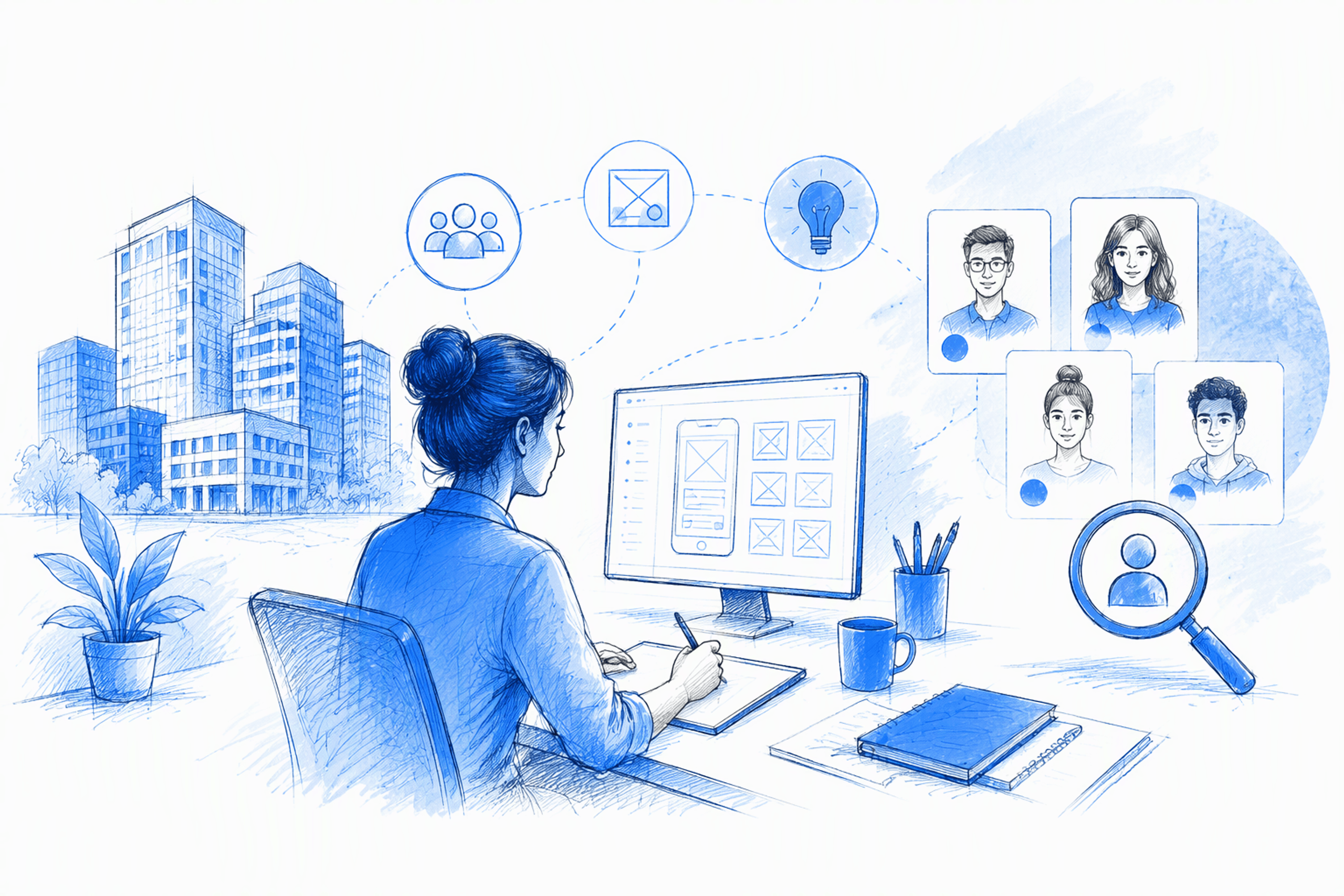
TL;DR
Companies that hire product designers include startups, SaaS businesses, fintech and healthtech teams, marketplaces, e-commerce brands, enterprise software companies, consumer apps, and agencies. We recommend hiring around the problem—not the industry. A senior freelancer may suit a focused initiative, while sustained design demand may justify a full-time role.
Table of Contents
- TL;DR
- Table of Contents
- Which companies hire product designers—and why?
- Why do companies hire product designers?
- Product designer vs UX, UI, and frontend designer
- What type of product designer does your company need?
- Freelance vs full-time vs agency product design
- How to write a focused product designer brief
- How to hire product designers
- Hiring a Bangalore-based product designer
- FAQ
- Bring us a product problem worth solving
Which companies hire product designers—and why?

Startups, SaaS businesses, fintech and healthtech companies, marketplaces, e-commerce brands, enterprise software teams, consumer apps, agencies, and innovation teams all hire product designers.
Employer categories tell only part of the story. Companies invest in product design to address unclear workflows, poor activation, inconsistent interfaces, conversion friction, difficult implementation, or an idea that needs to become a credible product.
Startups, SaaS, and zero-to-one product teams
Early-stage teams hire designers to define products, map journeys, narrow MVP scope, prototype key interactions, and test assumptions before development advances.
When priorities are changing and design demand is uneven, a senior freelancer can offer focused judgment without creating a permanent position too early. Full-time employment is not automatically the more serious choice.
Fintech, healthtech, marketplaces, and enterprise software
These products often involve complex workflows, permissions, accessibility requirements, compliance constraints, edge cases, and multiple user roles.
Design should help determine who can act, what information they need, how errors are prevented, and how risk is communicated. We prefer to involve design before technical requirements become difficult to change.
E-commerce, consumer apps, agencies, and innovation teams
These teams commonly need help with onboarding, discovery, checkout, engagement, experimentation, and concept development.
For example, an e-commerce company with checkout friction may need a growth-focused product designer rather than a cosmetic refresh. The designer should investigate the journey, prioritize changes, test assumptions, and support implementation.
Why do companies hire product designers?
Companies hire product designers to reduce uncertainty, improve usability, connect user needs with business goals, and make delivery more coherent.
Design can support improvements in task completion, activation, conversion, support demand, retention signals, and engineering rework. The exact measure depends on the product problem.
Common signals that design has become a business need
We look for signals such as:
- Users struggling with important journeys
- Weak activation, checkout, or feature adoption
- Inconsistent patterns across product areas
- Preventable usability issues reaching support
- Repeated rebuilding after late design changes
- Founders becoming design-decision bottlenecks
When developers make fragmented experience decisions by default, the problem is usually an ownership gap—not an engineering failure.
What product design can improve
Start with a baseline and a defined behaviour or decision. “Improve onboarding” is vague. “Help workspace administrators complete setup with fewer errors” gives the team a clearer objective.
Measures might include task completion, usability findings, support volume, conversion, delivery speed, or reduced rework.
When not to hire yet
Do not commission polished screens without a clear problem, access to evidence, a decision owner, or capacity to implement the work.
If the central uncertainty is still undefined, we recommend focused discovery first. That work can clarify risks and identify what should—or should not—be designed.
Product designer vs UX, UI, and frontend designer
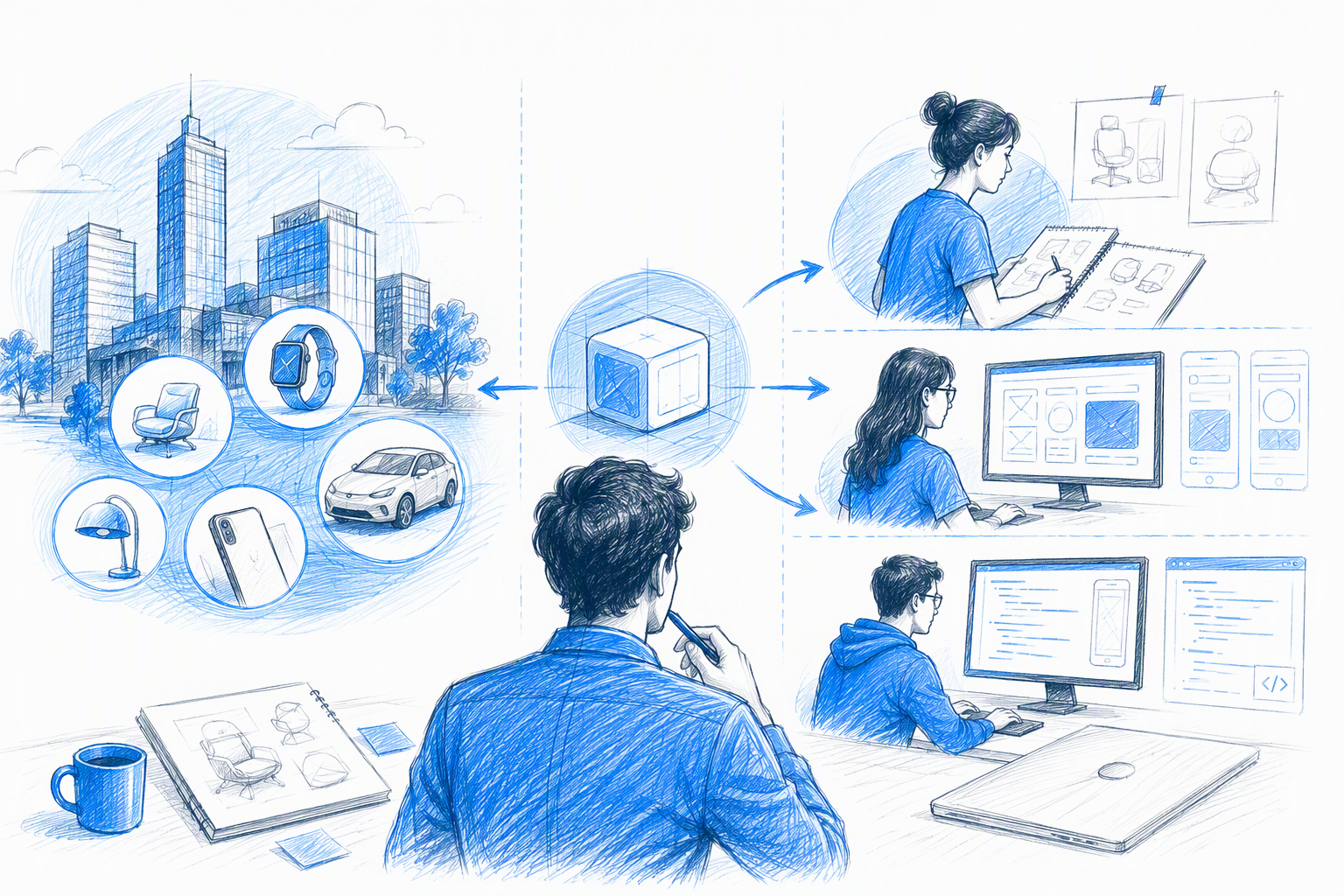
Titles vary, so we recommend hiring by responsibility. Product design usually covers broader ownership, from framing the problem through supporting the shipped experience. UX, UI, and frontend roles offer deeper specialization.
Choose the role based on the gap
- UX designer: Research, information architecture, usability, and complex flows
- UI designer: Visual systems, hierarchy, interaction details, and polish
- Frontend designer or developer: Production implementation and browser behaviour
- Product designer: Problem framing, UX, UI, validation, and implementation collaboration
Our scope-first guide to UI and UX design services explains these responsibilities in more detail.
What a designer-developer hybrid changes
Frontend fluency can improve feasibility, responsive design, prototypes, engineering communication, and design QA.
Still, define the boundary. Interactive prototyping, implementation support, design QA, and production code are different commitments.
Avoid the impossible all-in-one role
Do not expect one person to own research, strategy, UX, UI, brand, motion, copy, design systems, and full development equally well.
Separate essential ownership, useful supporting skills, and future capabilities. This keeps the role focused on the product’s main risk.
What type of product designer does your company need?
Common profiles include generalist, UX-heavy, visual, interaction, growth, design systems, and designer-developer hybrid product designers.
Match specialization to product risk
Choose UX depth when user needs or workflows remain unclear. Look for UI or interaction expertise when the product works but lacks clarity or consistency.
Growth designers suit activation and conversion work. Systems designers help when fragmented components slow delivery. Generalists often suit zero-to-one products where the work spans discovery, flows, prototypes, interfaces, and implementation support.
Match seniority to ambiguity
Producing defined screens differs from leading discovery, reducing scope, setting direction, and negotiating constraints.
We assess seniority by the uncertainty and ownership involved—not by the length of a designer’s software list.
Freelance vs full-time vs agency product design
Choose the operating model based on continuity, workload, urgency, specialization, and internal management capacity. Our comparison of a hybrid designer, agency, and in-house team explores these trade-offs.
When a senior freelancer is the better fit
Freelancers can suit MVPs, redesigns, growth initiatives, and other bounded problems. Benefits may include direct access, flexible duration, a defined scope, and the option to begin with paid discovery.
Our contract product designer hiring guide covers ownership, boundaries, and delivery expectations.
When full-time makes sense
A full-time designer makes sense when demand is sustained, company context is critical, and the business can support onboarding and career development.
Give the designer access to users, evidence, engineers, and decision-makers. Strategic ownership is difficult without those foundations.
When an agency model fits—and where it can add friction
Agencies can provide parallel capacity across research, brand, product design, motion, and development.
Before hiring, confirm who will perform the work, how much senior access is included, and whether the team will remain consistent. Compare coordination effort and decision speed as well as price.
How to write a focused product designer brief
A useful brief defines the business problem, users, evidence, constraints, decision rights, implementation boundary, expected outputs, and success measures.
Start with outcomes, not a task inventory
Replace “redesign the app” with a specific objective, such as reducing setup errors. Explain the product stage, priority journey, available evidence, and decisions the designer will own.
Define collaboration and implementation boundaries
State the stakeholders, engineering involvement, user access, review process, and approval owner.
Clarify whether the designer will hand off files, support implementation, conduct design QA, build prototypes, or write production frontend code.
Use a one-page brief template
Include:
- Problem and context
- Target audience
- Scope and exclusions
- Constraints
- Available research or data
- Expected outputs
- Implementation responsibility
- Success measures
We also recommend inviting candidates to challenge the brief. Strong product thinking is not passive compliance.
How to hire product designers
A practical process includes focused sourcing, portfolio review, judgment-based interviews, a paid trial where appropriate, reference checks, and a consistent scorecard.
Our guide to finding a product designer who can actually ship explains how to distinguish presentation skill from delivery ability.
Review portfolios for reasoning and shipped outcomes
Look for problem framing, constraints, trade-offs, iterations, engineering collaboration, and evidence that the work reached production.
Be cautious about speculative redesigns, unsupported impact claims, generic process diagrams, and polished screens with little interaction depth. These product designer portfolio examples and evaluation criteria can support a more consistent review.
Ask interview questions that reveal product judgment
Ask how the candidate would decide what to learn first, handle conflicting evidence, reduce scope, or respond when engineering constraints change the preferred direction.
Strong designers adapt their process to the product’s risks rather than reciting the same framework for every project.
Use a short paid discovery or design sprint
A paid trial can use a real, bounded problem with clear confidentiality, timing, compensation, and evaluation criteria.
Assess the candidate’s questions, prioritization, rationale, communication, artifacts, and response to feedback. Avoid unpaid speculative work.
Make the final decision with a scorecard
Score candidates on relevant experience, product judgment, UX depth, UI craft, collaboration, implementation awareness, communication, availability, and commercial fit.
Use references to validate ownership, reliability, and contribution during implementation.
Hiring a Bangalore-based product designer
A Bangalore-based independent designer can support Indian and international teams with UX thinking, UI craft, and implementation-aware decision-making.
Plan time-zone overlap and remote collaboration
Define workshop windows, asynchronous reviews, decision logs, and regular checkpoints. Planned overlap supports live collaboration, while written decisions keep work moving between meetings.
Make handoff and design QA part of the engagement
Align responsive states, components, interactions, edge cases, content behaviour, and acceptance criteria before development.
Design QA helps designers and engineers resolve practical gaps instead of treating handoff as the end of design ownership.
A focused alternative to a premature full-time hire
At amajaying, we work directly with teams that need senior UX thinking, distinctive UI craft, and implementation-aware decisions without agency layers.
This model can suit MVPs, redesigns, growth flows, complex workflows, and design-system initiatives.
FAQ
What jobs can product design experience lead to?
Common roles include Product Designer, UX Designer, UI Designer, Interaction Designer, Growth Designer, Design Systems Designer, and design-focused frontend specialist. Responsibilities matter more than titles.
Which is better: UI/UX or product design?
Neither is inherently better. UI or UX specialists suit focused visual, research, architecture, or usability needs. Product designers usually take broader ownership across framing, flows, interfaces, validation, and implementation.
What types of product designers are there?
Common types include generalists, UX-heavy designers, visual designers, interaction designers, growth designers, systems designers, and designer-developer hybrids. Choose according to the product’s main risk.
How much does it cost to hire a product designer?
Cost varies by market, seniority, specialization, duration, ambiguity, and implementation responsibility. We recommend comparing expected ownership, speed, management needs, and outcomes rather than hourly rates alone.
Does location matter when hiring?
Location can help with workshops, but domain fit, communication, time-zone overlap, judgment, and delivery quality often matter more for remote work.
Do fashion companies hire product designers?
Yes, although the title can be ambiguous. Fashion companies hire digital product designers for e-commerce journeys, internal tools, logistics platforms, and customer apps, alongside separate apparel and textile design roles.
Bring us a product problem worth solving
Need senior design ownership without rushing into a permanent hire? Share your product problem, evidence, constraints, and implementation needs with us at amajaying.com.