Contract product designer: a practical hiring guide for work that ships
Learn how to hire a contract product designer who brings senior judgment, collaborates with engineering, and delivers polished work. Explore the guide.
By Ajay Khatri ·

TL;DR
A contract product designer adds experienced product judgment for a defined project, period, or capacity gap without permanent headcount. The right partner does more than create polished Figma files: they clarify the problem, design complete experiences, work closely with engineering, and review implementation. We recommend evaluating reasoning and shipped work rather than portfolio size or the lowest rate.
Table of Contents
- What is a contract product designer?
- Contract product designer vs freelance designer, agency, or full-time hire
- When contract product design creates the most leverage
- How to find a product designer who can solve—and ship
- How to evaluate a contract product designer’s portfolio
- Use a paid discovery sprint before a larger commitment
- Contracts, rates, and scope without false certainty
- Onboarding a contract designer for fast momentum
- Frontend fluency and AI: what changes, what does not
- FAQ
- Turn the next product challenge into shipped work
What is a contract product designer?
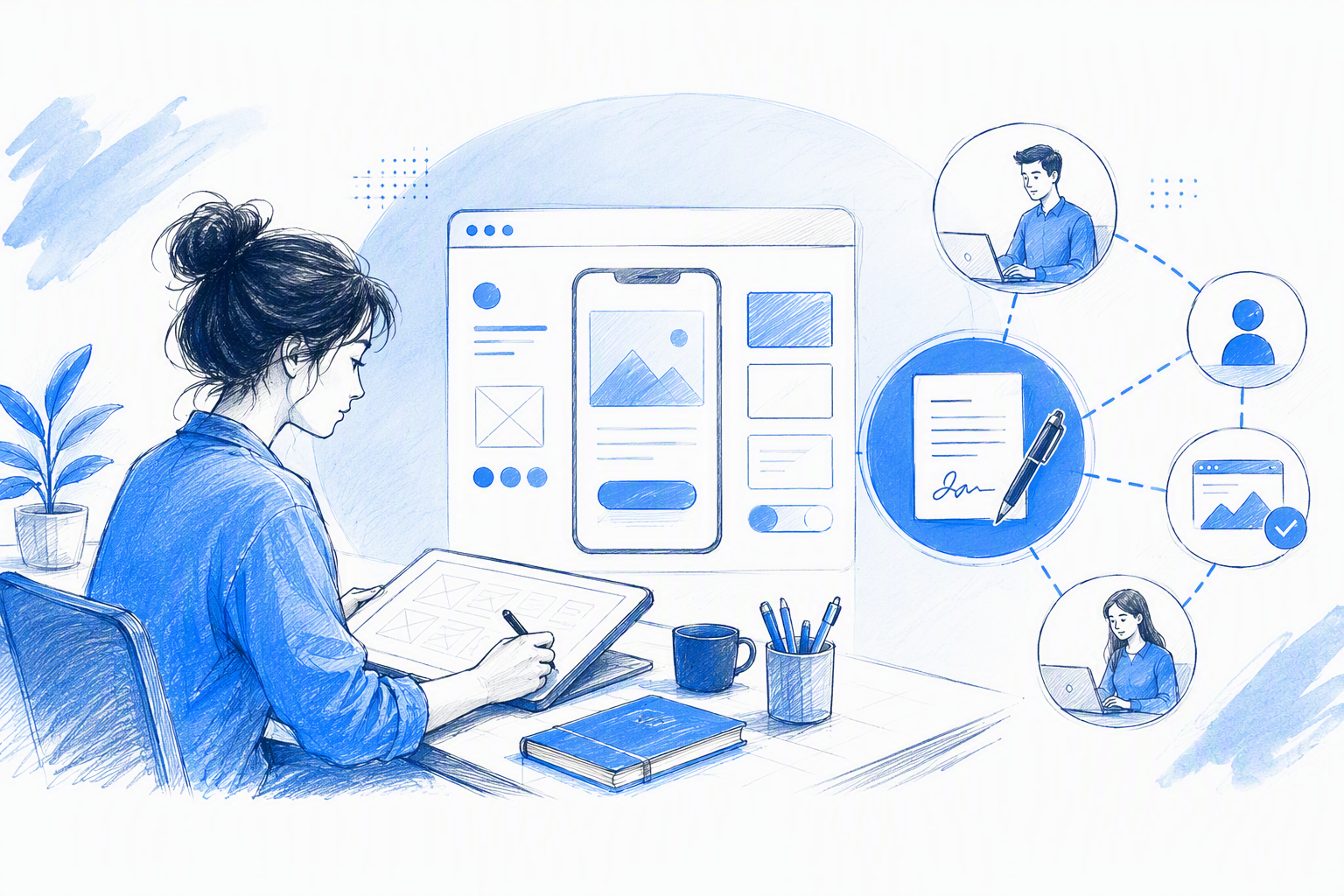
A contract product designer is engaged for a defined period, outcome, or capacity need. “Contract” describes the commercial arrangement, not a limited version of product ownership.
In our experience, the strongest contract designers work directly with product leaders, engineers, users, and decision-makers. They do not simply receive disconnected requests for screens. Their job is to connect user needs, business priorities, interface design, and technical reality.
From messy brief to shipped product
Contract product design may cover:
- Discovery and problem framing
- Research review and synthesis
- User flows and information architecture
- Wireframes, UI, and prototypes
- Design-system components
- Engineering handoff
- Implementation review
Complete product work also addresses edge cases, loading and error states, accessibility, responsive behaviour, permissions, and technical constraints.
What a contract designer should deliver
Typical outputs include flows, prototypes, UI specifications, component definitions, and implementation notes. Outcomes are broader: clearer decisions, less user friction, smoother delivery, or lower implementation risk.
We recommend shaping deliverables around the problem rather than forcing every engagement through the same process. Our guide to UI and UX design services explains how scope can follow the product need.
Contract product designer vs freelance designer, agency, or full-time hire
“Contract” and “freelance” often overlap. Freelance usually refers to independent working status, while contract describes the engagement structure.
| Model | Flexibility | Access | Best fit |
|---|---|---|---|
| Independent contract designer | High | Direct | Focused, evolving product work |
| Freelance product designer | High | Usually direct | Defined design assignments |
| Agency | Moderate | May be layered | Broad multidisciplinary programmes |
| Full-time hire | Lower initially | Direct | Continuous ownership |
| Staffing model | Role-dependent | Usually direct | Sourcing temporary capacity |
Choose an independent contract designer when
We favour this model when a team needs experienced support, the scope may evolve, and direct access to the person doing the work matters. One clear design owner can connect UX, visual direction, prototyping, and engineering collaboration without isolating those activities.
Choose a full-time hire, agency, or staffing model when
A permanent hire suits continuous ownership and long-term team development. An agency may fit a programme that needs several disciplines working in parallel. A staffing provider primarily helps with sourcing and placement.
We recommend comparing management layers, team consistency, knowledge retention, and coordination overhead—not just availability.
When contract product design creates the most leverage

Start by identifying the actual constraint:
- Missing specialist or senior expertise
- Temporary capacity pressure
- Unclear product direction
- Delivery or implementation risk
- A gap before permanent hiring
Contract support often suits MVPs, major features, redesigns, design systems, temporary cover, and pre-hiring momentum. It is a poor fit when designers cannot reach stakeholders, no one owns decisions, or the business objective remains undefined.
MVPs and uncertain product bets
For an MVP, we might begin with focused discovery to test the riskiest assumption, map the core flow, and define a buildable release. Evidence-based milestones are more useful than pretending every requirement is already known.
Redesigns, launches, and design systems
A redesign should consider analytics, user evidence, accessibility, system states, and technical constraints. For launches and design systems, the work should continue into implementation so active flows and component states are validated in the product—not abandoned in a design file.
How to find a product designer who can solve—and ship
Teams can search through referrals, professional networks, specialist communities, portfolios, and targeted outreach. We recommend searching for experience with the problem and working environment rather than choosing solely by industry labels or visual style.
Our guide on how to find a product designer who can actually ship covers the wider process. For Bangalore-based or remote work, we also assess timezone overlap, communication rhythm, stakeholder access, and proximity to engineering.
A useful brief includes the product problem, desired outcome, team, decision-maker, constraints, timeline, dependencies, and budget model.
What to look for in the first conversation
Strong designers ask about users, evidence, constraints, technical feasibility, dependencies, and decision ownership before prescribing an interface. We value people who challenge assumptions constructively rather than promising screens without understanding the problem.
Red flags before engagement
Watch for vague ownership claims, context-free mockups, missing trade-offs, and no explanation of what shipped. Developers should be active collaborators, not downstream recipients. Review our checks before signing a product design freelance contract before committing.
How to evaluate a contract product designer’s portfolio
Portfolio volume is weak evidence by itself. A transparent case study can reveal more than a collection of polished mockups.
Our scorecard covers:
- Problem framing
- User evidence
- Constraints
- Design decisions
- Iteration
- Outcomes
- Implementation quality
Separate the designer’s contribution from the wider team’s work. A résumé provides context, but demonstrated judgment matters more than a long list of contract product designer jobs. For more criteria, use our product designer portfolio guide.
Questions every case study should answer
Ask what the original problem was, which constraints shaped the solution, what changed after feedback, what the designer owned, and what reached production. Good answers show both reasoning and trade-offs.
Pixel-perfect is not the finish line
Review empty, loading, error, permission, responsive, and accessibility states. Ask how the designer handled technical constraints and reviewed implementation. Visual accuracy matters, but a successful product must also be coherent, resilient, and buildable.
Use a paid discovery sprint before a larger commitment
A paid discovery sprint lets both sides evaluate thinking, communication, craft, and technical collaboration on a real problem. Unlike unpaid speculative work, it creates useful insight while respecting professional expertise.
A strong discovery-sprint brief
Define the product problem, target user, available evidence, constraints, stakeholders, access, expected outputs, and the decision the sprint must support. Outputs might include an audit, journey, prioritised risks, prototype, technical review, or recommended next steps.
How to judge the sprint
We assess whether the designer improved the brief, surfaced hidden risks, made defensible decisions, and created momentum. Clear updates, productive critique, and effective engineering collaboration matter as much as the final artefact.
Contracts, rates, and scope without false certainty
The lowest hourly rate does not necessarily produce the lowest project cost. Weak framing, extra supervision, rework, and implementation gaps can erase the initial saving.
Common models include:
- Fixed scope: For stable requirements and acceptance criteria
- Day rate: For bounded audits, workshops, or support
- Retainer: For embedded capacity and iteration
- Milestones: For known problems with evolving solutions
Salary searches describe employee compensation. Independent rates may also account for operating costs, availability risk, expertise, uncertainty, and the absence of employee benefits. We recommend comparing overall value rather than salary or hourly price in isolation.
Match the commercial model to uncertainty
Use fixed pricing when outputs, dependencies, and acceptance conditions are stable. If the problem is clear but the solution is not, discovery followed by milestones is usually more honest. Retainers suit ongoing roadmap work and continuous collaboration.
Clauses that protect the work
A useful contract defines deliverables, exclusions, dependencies, feedback cycles, payment, acceptance, intellectual property, confidentiality, cancellation, and change requests. It should also explain what happens when feedback is late or requirements shift.
Onboarding a contract designer for fast momentum
Fast onboarding comes from accessible context, not a calendar packed with meetings. We recommend sharing the roadmap, user evidence, analytics, technical architecture, design system, brand assets, and relevant past decisions.
The day-one access checklist
Provide:
- Product and staging access
- Figma files and component libraries
- Research and analytics
- Issue tracking and technical documentation
- Current priorities, risks, and deadlines
- A stakeholder map and named decision-maker
Keep feedback direct and actionable
Consolidate stakeholder input and separate requirements from preferences. Bring engineering into discussions while options remain open, when technical feedback can still improve the solution.
Frontend fluency and AI: what changes, what does not
Frontend fluency can shorten the distance between design intent and implementation, especially for responsive or interaction-heavy products. A hybrid designer can test feasibility, refine components, and review production quality without replacing engineering.
Our approach to UI/UX design that survives the jump from Figma to frontend treats implementation as part of design quality.
Where AI genuinely helps
AI can support synthesis, early exploration, content variants, prototype iterations, and repetitive production tasks. Human review remains essential for accessibility, research interpretation, brand character, technical validity, and ethical risk.
What still requires senior product judgment
Experienced designers decide which problem deserves attention, reconcile conflicting evidence, navigate constraints, and identify what should not be built. Faster output is useful only when it supports a coherent and feasible product.
Quick answers for hiring teams
Compensation and rates vary by market, experience, specialisation, and working model. We compare total engagement value rather than treating employee salary and independent pricing as equivalent.
Before starting, confirm the problem, intended outcome, decision-maker, product access, evidence, engineering contact, constraints, and commercial model.
FAQ
What does a contract designer do?
A contract designer solves a defined product problem or provides design capacity for an agreed period. Their work may include discovery, flows, interface design, prototyping, design systems, handoff, and implementation review.
When should we hire a contract product designer?
We recommend contract support when a team needs specialist expertise, temporary capacity, help shaping an uncertain product, or momentum before a permanent hire.
How should we evaluate a contract designer?
Review their problem framing, constraints, decisions, contribution, outcomes, and shipped implementation. A polished portfolio is not enough without clear reasoning.
Is AI replacing product designers?
AI is changing parts of the workflow, particularly synthesis and production. Designers remain responsible for judgment, trade-offs, stakeholder alignment, accessibility, and product outcomes.
Is UI/UX work stressful?
It can be when deadlines, requirements, and decision ownership are unclear. Realistic milestones, direct feedback, stakeholder access, and early engineering involvement create a healthier engagement.
Turn the next product challenge into shipped work
If our combination of Bangalore-based UX thinking, distinctive UI craft, prototyping, and frontend-aware execution fits your next project, start a conversation with amajaying.com.