Companies hiring product designers: an employer’s readiness guide
Identify product bottlenecks, choose the right hiring model, and assess design judgment before you invest. Use this readiness guide to hire with confidence.
By Ajay Khatri ·
TL;DR
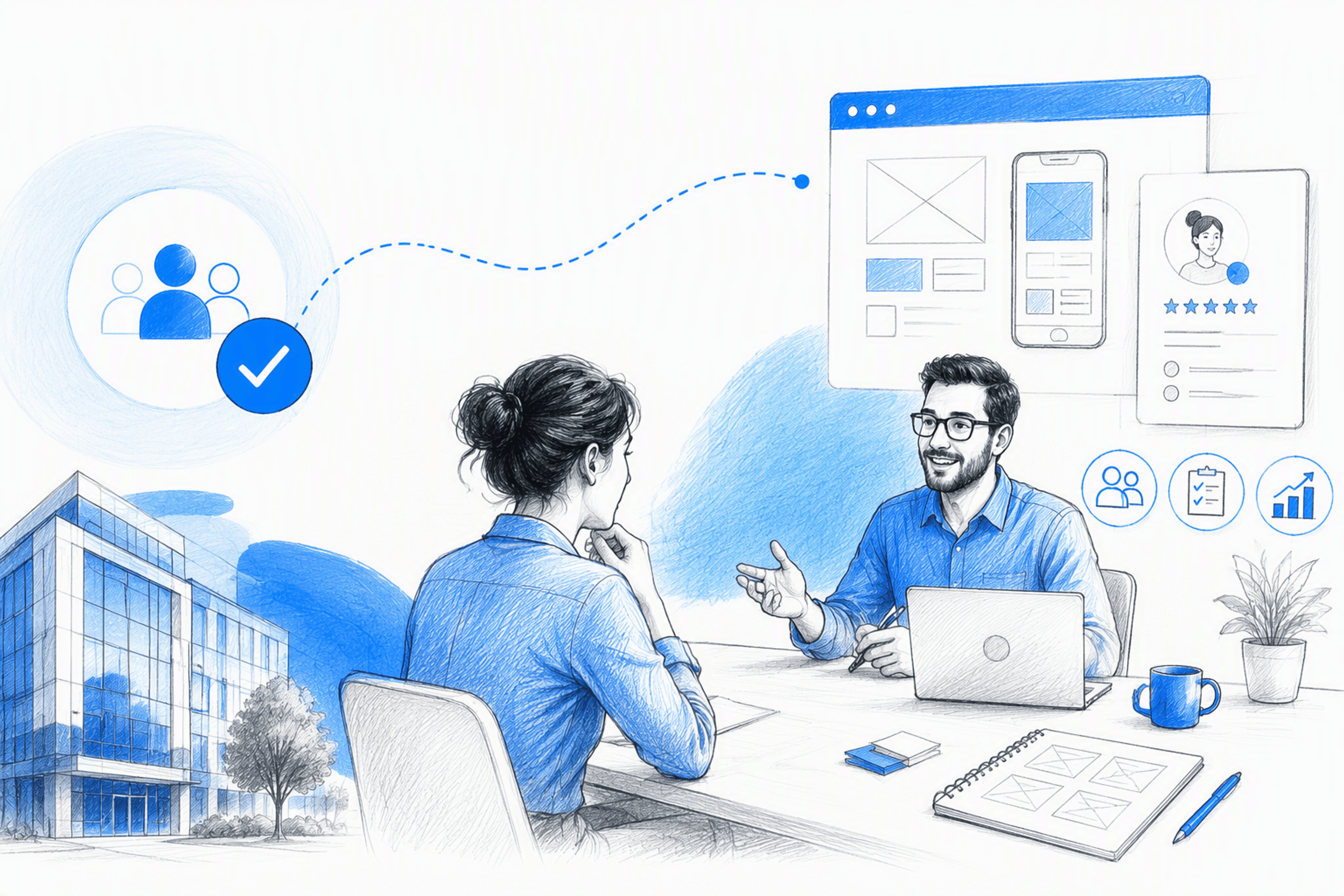
Companies hiring product designers should start with a costly product bottleneck, not a generic job description. Hire when unresolved experience decisions are affecting activation, support, launch confidence, or engineering time. Choose full-time or independent support based on the workload, assess decision-making rather than portfolio polish, and validate fit through paid, real-world work.
Table of Contents
- Companies hiring product designers should start with the bottleneck, not a company list
- Why companies hire product designers: seven practical triggers
- Turn the product problem into a focused hiring brief
- Choose full-time or independent product design based on workload
- Evaluate product thinking, not just polished portfolio screens
- Use a product designer hiring scorecard
- Validate fit with a paid, tightly scoped engagement
- What a product designer should deliver in the first 30 days
- Questions about companies hiring product designers
- FAQ
- Turn the bottleneck into a build-ready experience
Companies hiring product designers should start with the bottleneck, not a company list
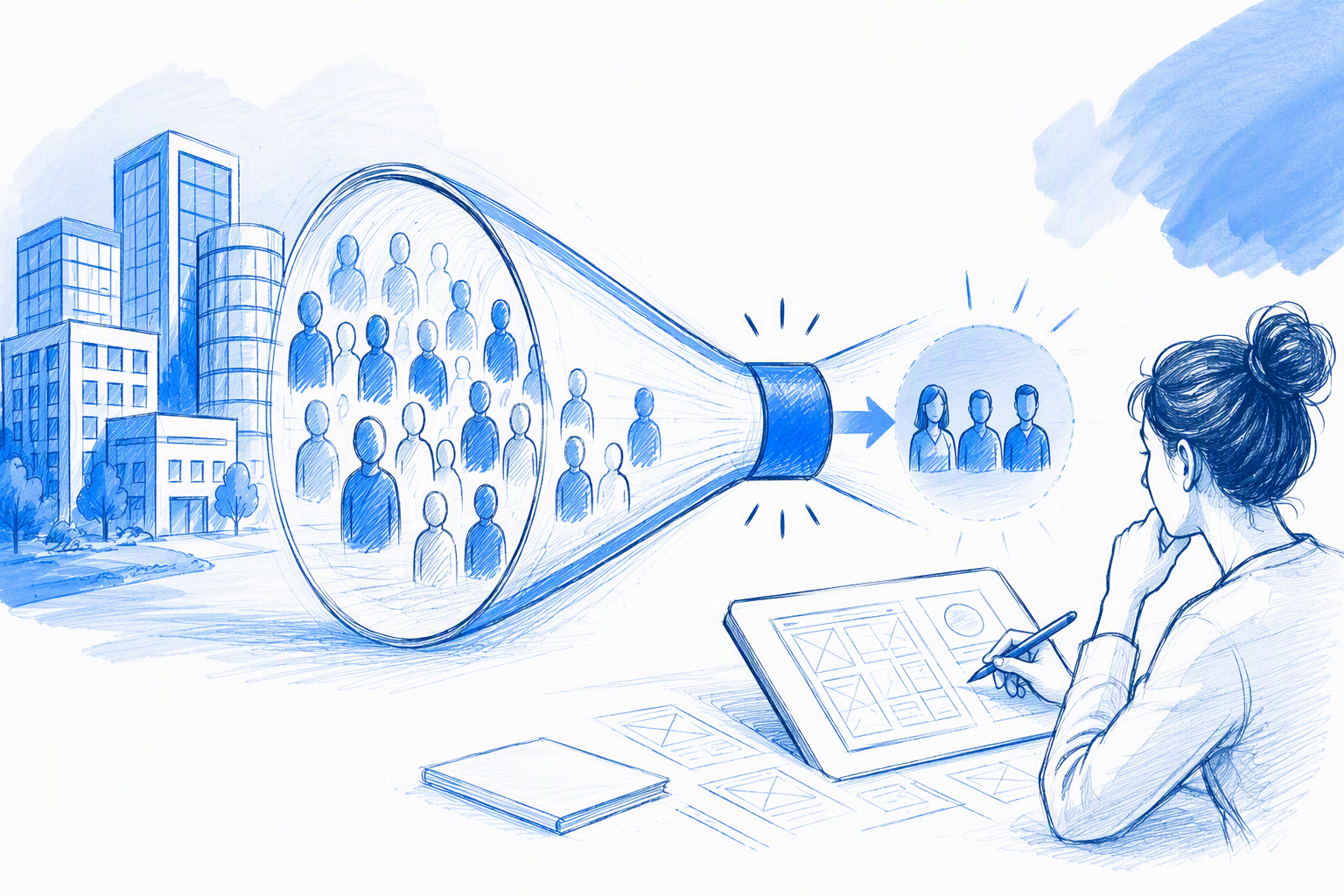
Not every growing company needs a full-time product designer. Hiring too early can create unfocused production work. Hiring too late leaves founders and developers making important experience decisions without enough evidence or ownership.
This is not a directory of famous employers or current vacancies. It is a readiness guide for teams that sense a product problem but have not yet defined the right design role.
We recommend considering a hire when unresolved experience decisions are affecting:
- Activation or conversion
- Retention and repeat use
- Support volume
- Launch confidence
- Engineering time
- Product consistency
- Stakeholder alignment
A product may function technically while users hesitate, get lost, or abandon key tasks. More features or a visual refresh will not solve that if nobody owns the experience from flow through implementation.
Teams assessing broader hybrid capabilities can read our guide to companies that hire product designers with UX, UI, and frontend range. Here, we focus on what to do once a genuine need has emerged.
Why companies hire product designers: seven practical triggers
Companies usually hire product designers because product ambiguity has started creating business or delivery problems.
Seven common triggers are:
- Weak activation or conversion
- Repeated usability complaints
- High-impact interface inconsistency
- A major launch or workflow change
- Engineering time lost to UX decisions
- Stakeholder disagreement about user needs
- Design intent repeatedly lost during implementation
These are signals, not assignments. “The UI feels generic” is a symptom. Clarifying a critical journey, improving its hierarchy, and developing a distinctive direction is an assignment.
Weak activation or conversion
Suppose users complete signup but abandon the first meaningful workflow. The brief should not be “improve onboarding.” It should ask where value becomes unclear, what creates hesitation, and which change is worth testing.
Define the affected step and review the available evidence before work begins. Design can improve the journey, but activation also depends on positioning, traffic quality, reliability, and underlying product value.
Repeated usability complaints and support issues
One complaint rarely justifies a redesign. Repeated friction around the same journey deserves attention.
A designer can review support themes, audit the workflow, form hypotheses, prototype changes, and help engineering implement the strongest direction. The aim is not to follow every request literally. It is to identify the experience failure behind recurring complaints.
Inconsistent interfaces and design debt
We prioritise inconsistencies that damage comprehension, trust, accessibility, speed, or implementation efficiency.
A design system should not automatically be the first deliverable. Standardising an unsettled product can make weak decisions harder to change. Fix the critical experience first, then systematise patterns that prove durable.
A major launch, repositioning, or workflow
Launches expose unresolved decisions quickly. User needs, information architecture, interaction logic, visual direction, and technical constraints must align before release.
For an AI product, this may involve clarifying unpredictable outputs, recovery paths, interaction states, trust cues, and information hierarchy. Surface polish alone is not enough.
Engineering time is being consumed by UX decisions
Developers influence the experience, but they should not repeatedly invent flows, hierarchy, responsive rules, empty states, and error handling because direction is missing.
The same problem appears when approved designs lose their intended hierarchy or behaviour in production. A capable product designer makes decisions explicit, works through edge cases, and stays involved during implementation.
Turn the product problem into a focused hiring brief
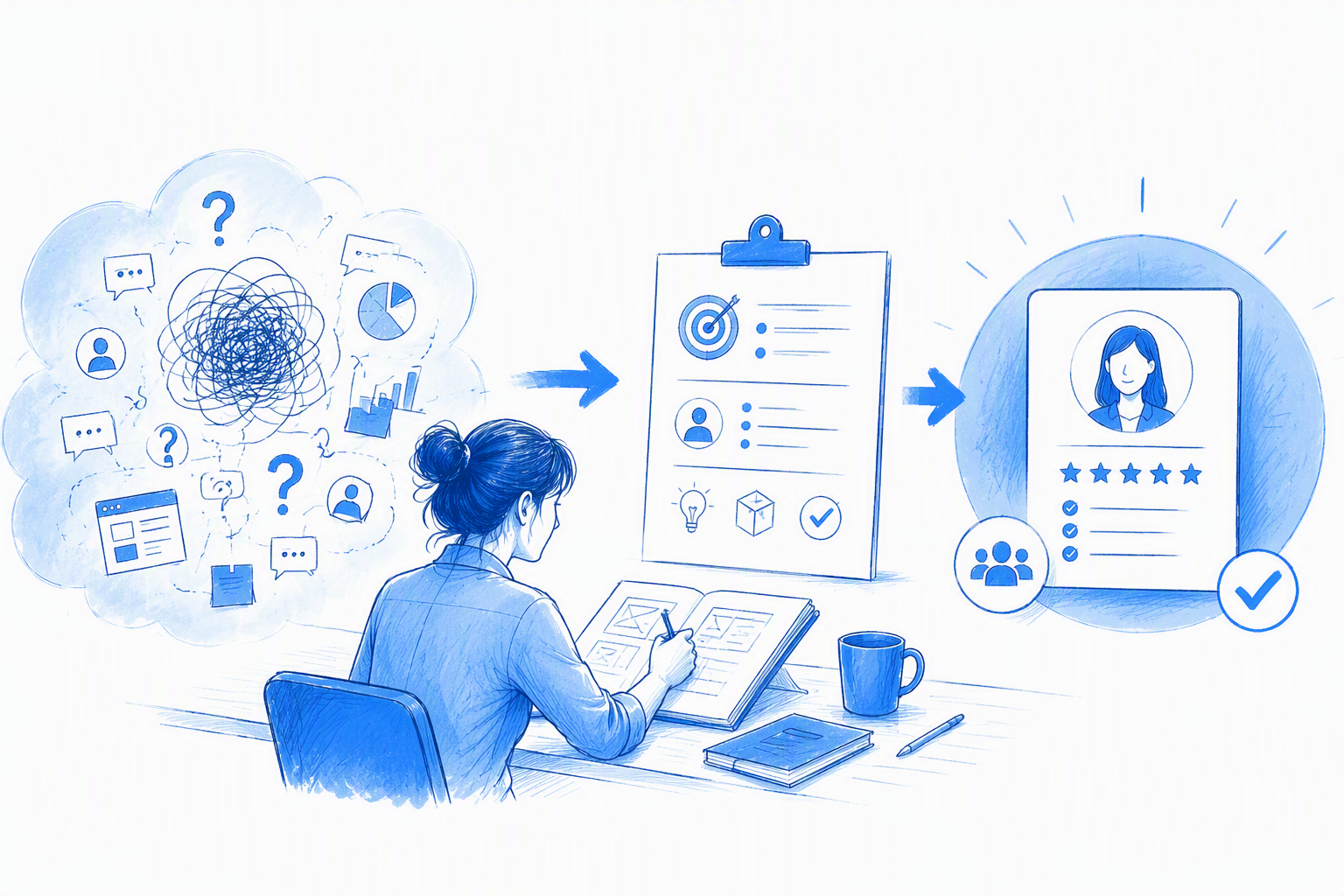
A useful hiring brief begins with the product problem, not the title.
Define:
- The business problem creating drag
- The affected users and priority workflow
- Known commercial and technical constraints
- The internal decision-maker
- The outcome the work should support
Avoid combining customer research, branding, UI production, design systems, marketing pages, and frontend development into one undefined request. Hybrid range can reduce handoffs, but it does not remove the need for scope.
Clarify what access the designer will receive, including product analytics, support themes, customer context, roadmap priorities, and engineering constraints. Success criteria should focus on decisions and product progress, not outcomes the designer cannot control alone.
Our buyer’s guide to build-ready UI/UX design services explains what should exist between discovery and production.
A concise brief template
Use this structure:
- Problem: What is failing or consuming capacity?
- Scope: Which journey or feature is included?
- Decision: What must the team learn or choose?
- Evidence: What research, data, or customer context exists?
- Outcome: What should be validated, designed, or shipped?
For example: “New users complete signup but abandon workspace setup. We need to identify the main point of confusion, choose a revised flow, prototype its critical states, and prepare it for implementation.”
That is more actionable than “We need a UX/UI designer to improve the app.”
Choose full-time or independent product design based on workload
The right hiring model depends on duration, workload consistency, urgency, ownership needs, internal support, and budget.
Choose a full-time product designer when there is:
- A durable stream of product work
- A need for ongoing organisational ownership
- Sufficient management and research access
- A clear role beyond the immediate project
Consider an independent designer when the challenge is concentrated, speed matters, or senior execution is needed before permanent headcount makes sense. A startup with one critical launch and no predictable design workload afterward should not default to a permanent role.
Independent support still requires a responsible internal decision-maker, dependable engineering collaboration, and timely access to evidence. Our comparison of freelance, full-time, and agency product design hiring can help teams assess the trade-offs.
When a Bangalore-based independent designer can be the practical fit
A Bangalore-based independent designer can suit compact teams seeking direct collaboration across UX, UI, and frontend-aware execution. The model can reduce handoffs while keeping responsibilities clear.
Agree on working-hour overlap, communication cadence, review participants, decision rights, and implementation involvement before starting. Geography matters less than a working model that supports prompt, documented decisions.
At amajaying.com, our approach to freelance product design for startups connects ambiguous product problems to validated flows, distinctive interfaces, and implementation support. It works best when the team brings us a defined challenge rather than a vague request for extra capacity.
Evaluate product thinking, not just polished portfolio screens
Beautiful screens are weak evidence when separated from the decisions behind them. A mock-up cannot show whether the designer framed the right problem, handled constraints, aligned stakeholders, or influenced what shipped.
During a portfolio review, ask candidates to explain:
- The original brief and how it changed
- Constraints and rejected directions
- Trade-offs behind the chosen flow
- Collaboration with product and engineering
- Differences between prototype and production
- Their specific contribution
- The limits of the available outcome evidence
Large-team case studies need particular care. Ask which decisions the candidate personally owned. We look for evidence that a designer can simplify ambiguity and move work towards production. Our guide to product designer portfolio criteria for hiring teams offers a fuller review framework.
Questions to ask during a case-study walkthrough
Ask each candidate the same core questions:
- How did the problem definition change?
- Which direction did you reject, and why?
- What constraint most affected the experience?
- How did engineering input change the design?
- What shipped differently from the prototype?
Strong answers show uncertainty, compromise, and ownership rather than presenting the process as perfectly linear.
Red flags behind a polished presentation
Watch for these signs:
- Only ideal-state screens appear
- Loading, error, empty, permission, and responsive states are missing
- Research is mentioned but changes no decision
- Personal work cannot be separated from team output
- Outcomes are claimed without credible evidence
- Implementation is treated as someone else’s problem
Presentation quality matters, but it cannot replace product judgement.
Use a product designer hiring scorecard
A hiring scorecard reduces preference-driven decisions. Assess every candidate against the same role-specific criteria, record evidence, and weight categories according to the actual bottleneck.
Product judgement and interaction design
Review problem framing, prioritisation, flow logic, state handling, and trade-off quality. Strong candidates distinguish a user request from the underlying product problem.
They should also know when lightweight testing could change a decision—and when more research would only delay progress.
Visual craft and systems thinking
Assess hierarchy, typography, component consistency, responsive composition, and visual distinctiveness. Strong UI should make the product easier to understand, not merely more dramatic.
Systems thinking also means knowing when not to systematise. Workflows that are still changing rarely need an elaborate component library.
Communication and collaboration
Assess whether the designer can align founders, product managers, engineers, and other stakeholders around a decision. Look for concise documentation, direct questions, clear rationale, and visible management of unresolved risks.
Good collaboration does not mean accepting every suggestion. It means identifying useful feedback and explaining the trade-offs behind the final direction.
Frontend literacy and implementation awareness
Review the candidate’s understanding of responsive behaviour, accessibility, component feasibility, and edge states.
Frontend literacy does not require every designer to write production code. It means understanding how interface decisions behave in a browser and collaborating through implementation instead of disappearing after handoff.
Validate fit with a paid, tightly scoped engagement
We do not recommend speculative unpaid redesigns. They lack essential context and rarely reflect the collaboration required in real product work.
Instead, use a contained problem from the actual product. Protect sensitive information, but provide enough context for meaningful decisions.
Define:
- Compensation
- Scope and time box
- Confidentiality and ownership
- Participants and decision-maker
- Expected deliverables
- Evaluation criteria
Assess the questions asked, priorities chosen, rationale, response to feedback, communication, and implementation awareness. Our guide to hiring a contract product designer who can help the team ship provides a structured evaluation process.
Example paid engagement
Choose one priority journey, such as onboarding, checkout, account setup, or a central AI interaction.
The engagement might include:
- A rapid experience audit
- Key questions and assumptions
- A proposed flow
- A focused prototype
- Design rationale
- Implementation notes
End with a joint review of decisions, unresolved risks, and next steps. The purpose is to test mutual fit, not obtain a large speculative redesign at minimal cost.
What a product designer should deliver in the first 30 days
The first month should create clarity and momentum, not an instant redesign of the whole product. Outputs must stay tied to the agreed bottleneck.
Days 1–10: understand and prioritise
The designer should review the product, available evidence, priority journeys, technical constraints, roadmap, and stakeholder assumptions.
Expected outputs include a concise audit, a sharper problem definition, and agreement on the highest-value decision. This phase should narrow the work rather than produce a catalogue of unrelated improvements.
Days 11–20: explore and validate
Next, the designer can map the flow, prototype the critical interaction, and test where evidence could change a real decision.
The work should establish an appropriate UI direction and expose important states. It is rarely the right moment to systematise the entire product.
Days 21–30: refine and support implementation
The final phase should resolve key states, responsive behaviour, component needs, and implementation questions.
The designer should collaborate with engineering, review the build, record intentional deviations, and document next priorities. A strong first month ends with clearer direction and work moving towards users.
Questions about companies hiring product designers
Searches for companies hiring product designers often mix employer readiness with job discovery. These are different needs.
Is there demand for product designers?
Current job boards show product design openings across software, logistics, insurance, fintech, and other digital-product sectors. Availability varies by location, seniority, speciality, and hiring cycle.
For employers, broad market demand matters less than the cost of the current bottleneck. Persistent usability problems or engineering time spent resolving interface questions may justify design support regardless of wider hiring trends.
Which companies are best for product designers to work at?
The best environment depends on design maturity, access to decisions, mentorship, ownership, product complexity, and whether the company reliably ships design work.
Brand recognition does not guarantee meaningful influence. We recommend assessing the actual team, role, decision rights, and expectations.
How do I find companies hiring product designers near me or remotely?
Use current job boards and official company careers pages. Listings change frequently, so confirm the location, remote-work policy, level, and application requirements at the source.
This guide helps companies prepare to hire; it is not a live vacancy directory.
Does Google hire product designers?
Large technology companies may advertise product design roles when openings are available. Candidates should check the official careers site for current requirements rather than relying on static employer lists.
How can someone get hired as a product designer?
Candidates should demonstrate problem framing, trade-offs, collaboration, implementation awareness, and credible outcomes—not only polished screens.
Strong case studies explain what changed, which constraints mattered, what the candidate personally contributed, and how the shipped result differed from the prototype.
FAQ
When should a startup hire its first product designer?
Hire when recurring experience decisions are affecting activation, support, launch confidence, or engineering capacity. The startup also needs a defined problem, an internal decision-maker, and engineers who can collaborate. If the workload is concentrated, an experienced independent designer may be more practical than an immediate permanent hire.
Should we hire a UX designer, UI designer, or product designer?
Choose based on the bottleneck. A research-heavy discovery problem may need deeper UX expertise, while a stable flow with weak hierarchy may need stronger UI craft. Compact teams often benefit from a product designer who combines interaction design, interface craft, and implementation awareness.
How long should a paid product design trial last?
There is no universal duration. Scope it narrowly enough to remain fair but broadly enough to reveal reasoning and collaboration. Agree on compensation, access, deliverables, ownership, participants, and evaluation criteria before work begins.
What is the biggest product designer hiring mistake?
A common mistake is hiring against a vague desire for “better UX” rather than a defined product decision. Start with the affected users, priority journey, available evidence, constraints, and outcome the team needs.
Does every startup need a design system immediately?
No. A design system becomes useful when stable patterns need to scale. If the core workflow is unresolved, standardisation can multiply weak decisions. Validate the high-impact experience first, then turn durable patterns into a practical system.
Turn the bottleneck into a build-ready experience
If a critical journey is confusing, generic, or repeatedly lost between design and production, work with amajaying.com to connect UX thinking, distinctive UI craft, and frontend-aware execution around one focused product challenge.