Product designer: what the role should deliver from discovery to launch
Learn what a product designer should deliver, from discovery and visual craft to implementation, launch, and iteration. Explore the skills that drive results.
By Ajay Khatri ·
TL;DR
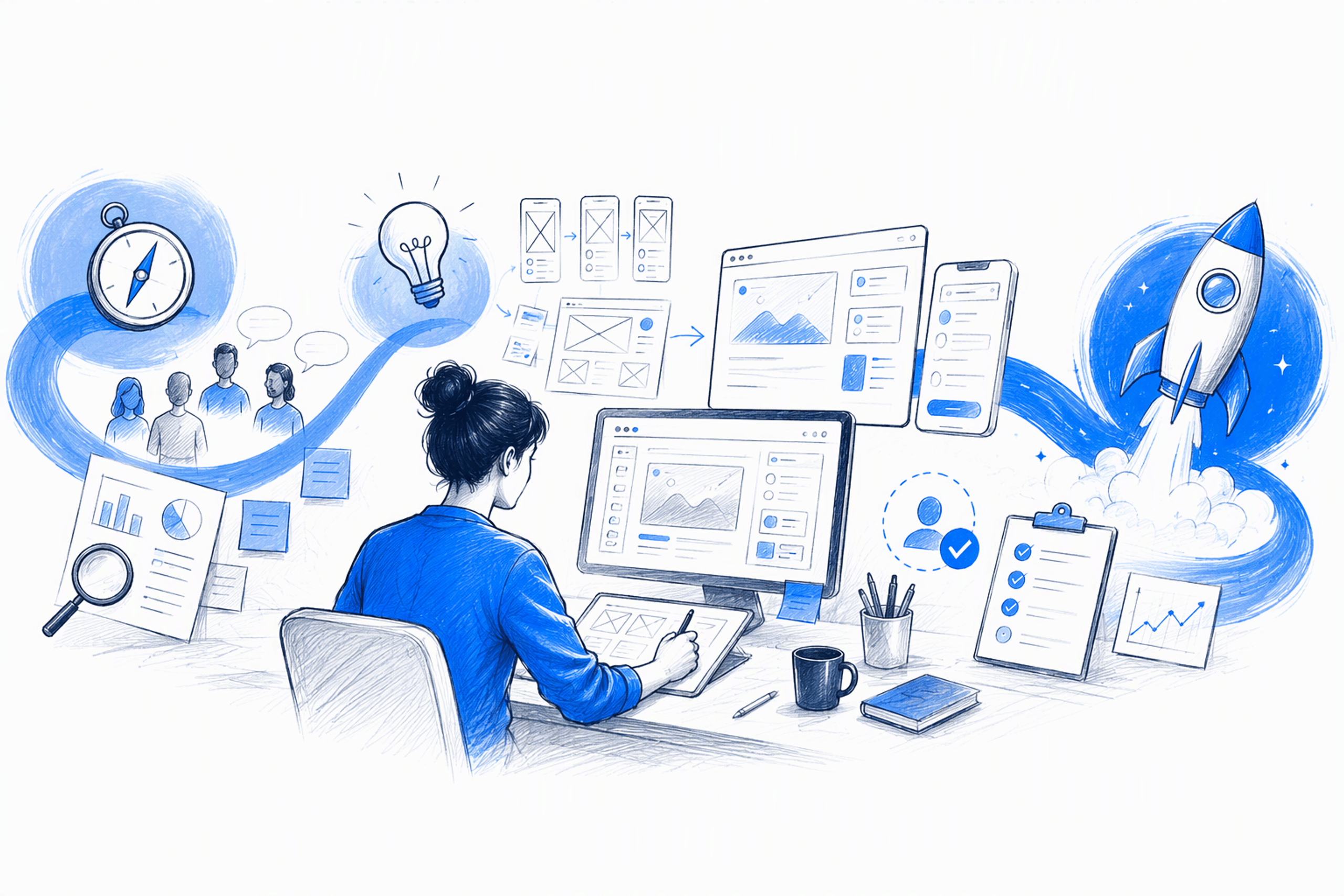
A strong product designer turns unclear user and business problems into useful, distinctive, buildable experiences. We recommend assessing product thinking, visual craft, technical awareness, collaboration, and shipped outcomes—not polished Figma screens alone. The right designer remains involved through implementation, testing, and iteration.
Table of Contents
- TL;DR
- What a product designer actually does
- How the product designer role changes by company stage
- What end-to-end product ownership looks like
- The skills that matter when hiring a product designer
- How to evaluate a product designer portfolio
- When to hire an independent product designer
- FAQ
- Work with a product designer who stays through execution
What a product designer actually does
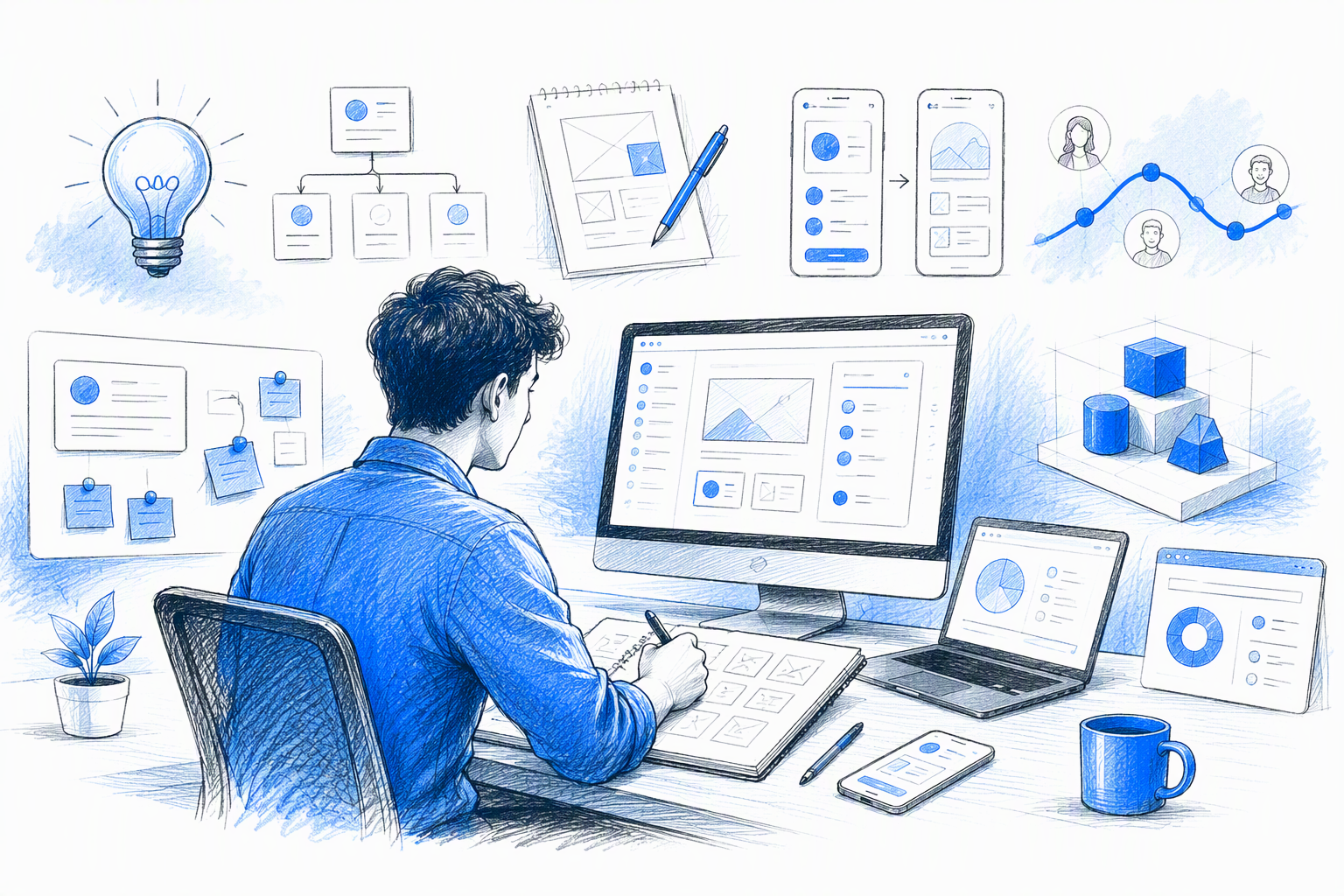
A strong product designer is not defined by how many research methods or design tools they can list. The real test is whether they can turn ambiguity into a useful, distinctive, and buildable product.
The role sits between user needs, business goals, visual communication, and technical delivery. Responsibilities may include user research, competitor analysis, journey mapping, information architecture, wireframes, prototypes, interface design, testing, and collaboration with engineering.
That broad definition creates a hiring challenge. One candidate may specialise in research, another in interface craft, and another may work across discovery, UX, UI, and implementation. All three can hold the same title.
We look for evidence that a designer can answer five practical questions:
- What user or business problem are we solving?
- What evidence supports that problem?
- Which solution is worth building first?
- How will the experience work across states and screen sizes?
- What happened after the solution reached users?
The output is not simply a set of screens. It is a chain of decisions leading to a product that can be released, evaluated, and improved.
Consider a product with recurring user complaints, weak conversion, and an approaching deadline. The designer should not begin by polishing the dashboard. They should locate the friction, connect it to a business goal, examine available product or support data, and decide which assumptions need validation.
The first deliverable might be a clearer journey, a prioritised problem statement, or a rough prototype. High-fidelity UI should appear when it helps the team make a decision, not because polished screens are the default starting point.
How the product designer role changes by company stage
Product design responsibilities depend on the organisation. A title tells us little without context about the team, product maturity, and expected ownership.
Startups
In an early-stage startup, a product designer may move between founder conversations, user interviews, flows, UI, prototypes, and developer collaboration within the same week. Speed matters, but rushed decisions can create avoidable rework.
The designer needs to identify the smallest credible release without reducing the experience to disconnected features. That requires comfort with incomplete information, changing priorities, and practical trade-offs.
Focused evidence may be more useful than a long research phase. Targeted conversations, support themes, product analytics, and a testable prototype can provide direction for the next decision. The goal is to learn enough to move responsibly.
Scale-ups
At a scale-up, the product often has active users, design debt, and several teams working across connected journeys. The product designer must balance feature delivery with consistency, adoption, retention, and system-level thinking.
Design systems help, but they do not replace product judgement. Applying standard components to every problem can create a consistent yet generic experience. Good designers know when to reuse, when to extend, and when a distinctive interaction serves a real purpose.
Established organisations
In larger organisations, responsibilities tend to be more specialised. Researchers, content designers, product managers, analysts, design-system teams, and frontend engineers may each own part of the process.
The product designer’s value lies partly in synthesis. They connect evidence and constraints across disciplines, explain their rationale, manage dependencies, and keep the experience coherent despite organisational boundaries.
Before opening a role, define the actual gap. If the team expects one person to handle discovery, complex UX, polished UI, prototyping, and implementation support, say so. Our guide to finding a product designer who can actually ship explains how to make that requirement concrete.
What end-to-end product ownership looks like
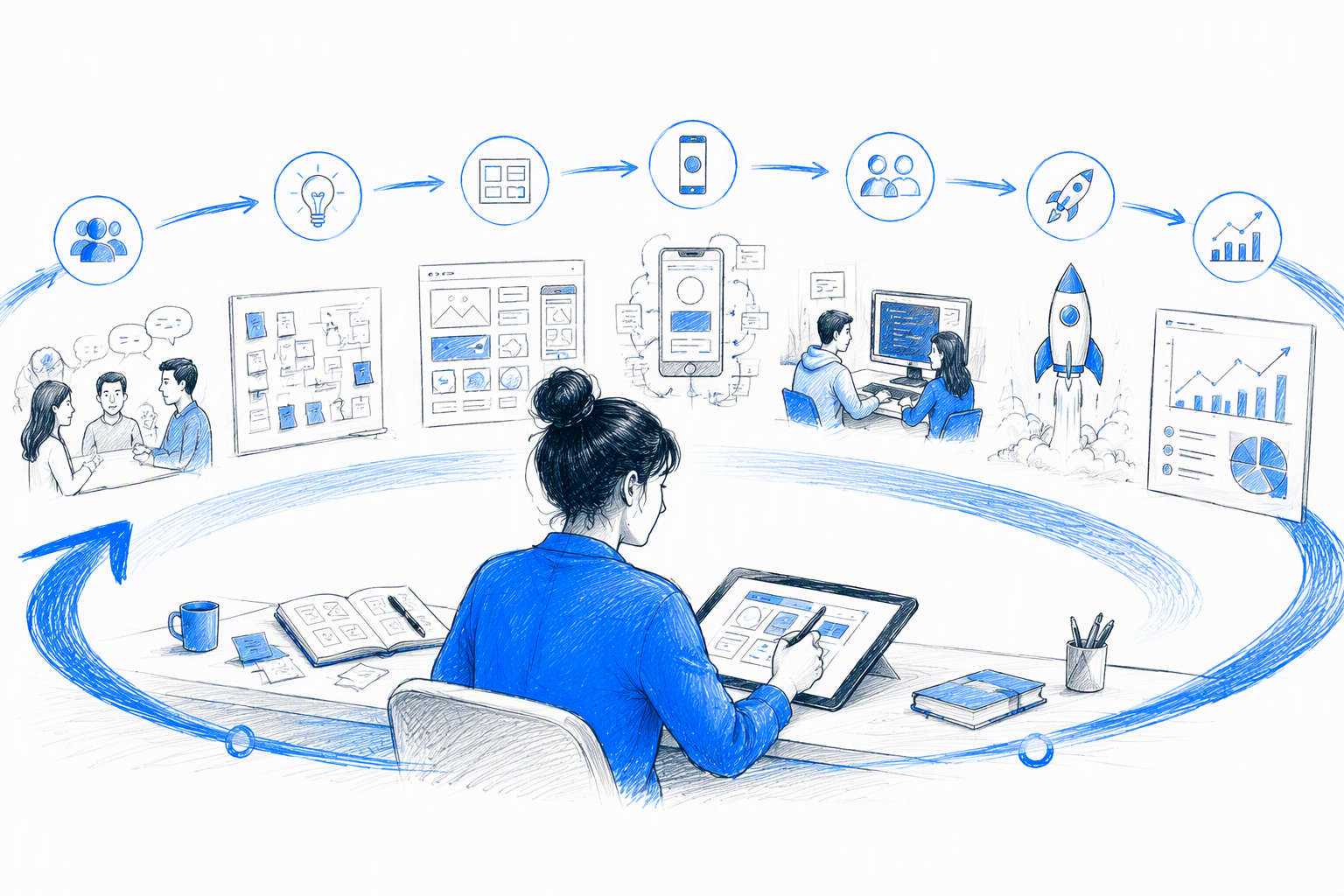
“End-to-end” is an overused description in product design. It means little unless the designer can show the decisions, trade-offs, collaboration, and outcomes behind the finished work.
Genuine ownership usually covers four connected phases.
Framing the problem
The designer should understand the user need, commercial objective, constraints, and definition of success. Depending on the project, success might relate to activation, conversion, retention, task completion, usability, support demand, or development rework.
This phase should reduce uncertainty. It should not become an indefinite discovery exercise that delays contact with the product.
Exploring and validating directions
Designers may use flows, journey maps, sketches, wireframes, prototypes, interviews, usability testing, or A/B testing. MVP definition and user journey mapping also sit within the broader product design toolkit.
The method should fit the decision. Testing navigation does not require a polished interface, while exploring trust or brand perception may call for greater visual fidelity. We prefer the lightest method that can produce credible evidence.
Designing the complete experience
A convincing happy path is not enough. Product design must account for loading, empty, error, validation, permission, success, and recovery states.
Responsive behaviour also needs deliberate thought. A desktop layout cannot simply collapse into a narrow column and become an effective mobile experience. Hierarchy, interaction patterns, content density, and touch behaviour may all need to change.
Staying involved during implementation
Static specifications cannot anticipate every browser behaviour, technical constraint, or edge case. Ongoing designer-developer collaboration is more useful than treating handoff as the end of design.
A designer with frontend literacy can discuss component logic, responsive rules, semantic structure, interaction states, and implementation trade-offs early. Knowledge of HTML, CSS, and JavaScript is relevant because it helps designers understand how interface decisions translate into production.
Teams considering flexible support can review how freelance product design turns product problems into shipped experiences. In our experience, the working process matters as much as the contract type.
The skills that matter when hiring a product designer
Tool fluency is useful, but Figma proficiency alone does not prove product design ability. Tools change; sound judgement remains valuable.
We group the essential skills into six areas:
- Problem framing: Separating visible symptoms from underlying user and business problems.
- Research judgement: Choosing evidence that is appropriate to the decision.
- Interaction design: Creating clear flows, hierarchy, feedback, and recovery paths.
- Visual design: Producing coherent, accessible, and distinctive interfaces without sacrificing usability.
- Commercial awareness: Connecting design decisions to a meaningful product or business outcome.
- Technical collaboration: Understanding frontend constraints and working with developers during implementation.
Communication connects all six. Designers need to explain why a direction exists, which assumptions remain uncertain, and which trade-offs they made. Their rationale should be clear enough to question without turning every critique into a defensive presentation.
We also value taste, but not as decoration. Strong visual craft can establish hierarchy, support trust, and differentiate a product. The designer’s job is to pursue that distinctiveness without making familiar tasks harder to understand.
We treat frontend literacy as a core capability for designers working on digital products. It helps feasibility shape concepts from the start, improves responsive decisions, and narrows the gap between design and production.
For a time-bound or project-specific need, our contract product designer hiring guide can help teams define scope, access, responsibilities, and delivery expectations before work begins.
How to evaluate a product designer portfolio
Many portfolios look polished at first glance. The better question is not “Does this look good?” but “Does this show that the designer can solve the kind of problem we have?”
Start with the case-study setup. A strong portfolio makes the product context, audience, constraints, responsibilities, and objective clear. If someone presents a dramatic redesign without explaining the original problem, the final screens prove little.
Look for evidence of:
- A specific problem rather than a broad design challenge
- The designer’s actual contribution within the team
- Research or evidence connected to decisions
- Alternatives considered and rejected
- User, business, and technical constraints
- Interaction states beyond the ideal journey
- Collaboration with product and engineering
- Shipped work or credible implementation detail
- Outcomes, lessons, or a planned next iteration
Treat perfectly linear case studies with caution. Real projects involve changing requirements, failed ideas, technical limits, and negotiation. A credible designer can discuss those moments without losing the thread of the story.
When metrics are available, ask how design contributed rather than assuming causation. Conversion, retention, task success, support volume, and rework may be informative, but product results usually reflect work across several functions.
If metrics are unavailable, look for other evidence: usability findings, implementation quality, stakeholder alignment, reduced ambiguity, or clearer product direction. Our review of product designer portfolio examples and hireable evidence offers a more detailed framework.
Use the interview to test the portfolio narrative. Ask the candidate to explain a difficult trade-off, an idea that failed, an engineering constraint that changed the design, and a decision they would revisit. These answers reveal more than another tour of polished mockups.
When to hire an independent product designer
An independent product designer can suit a company that needs senior, hands-on ownership without dividing the work among several specialists or immediately creating a permanent role.
This model may work well when:
- A new product or feature needs definition and delivery
- An existing journey has usability or conversion problems
- The interface works but lacks a clear visual identity
- Internal teams need temporary design capacity
- Handoffs regularly create development rework
- The company needs focused expertise for a defined period
The main advantage is continuity. One person can retain context from problem framing through interaction design, UI, prototyping, and implementation support. Fewer transitions may reduce information loss and simplify decisions.
Independence does not mean isolation. The designer still needs access to founders, product managers, users, data, developers, and relevant stakeholders. Without that access, even an experienced practitioner must rely heavily on assumptions.
Before signing, establish the business problem, decision-makers, deliverables, collaboration rhythm, technical environment, and meaning of “done.” For a structured assessment, use these eight checks for product design freelance hiring.
For Bangalore-based teams, local availability may simplify workshops and collaboration, but location should not replace capability. At amajaying.com, we combine clear UX thinking, distinctive UI craft, frontend awareness, and ownership that continues into production.
FAQ
What skills does a product designer need?
A product designer needs problem framing, user research, interaction design, prototyping, visual design, communication, and commercial judgement. We also value frontend literacy because it supports feasibility and developer collaboration. Strong designers connect these capabilities instead of treating research, UI, and delivery as separate activities.
What careers are related to product design?
Related roles include UX designer, UI designer, UX researcher, interaction designer, visual designer, service designer, content designer, information architect, design engineer, design systems designer, industrial designer, design strategist, and creative director. Responsibilities overlap, so we recommend comparing the actual scope rather than relying on job titles alone.
What do product designers earn?
Earnings vary by location, seniority, industry, company size, employment model, and scope. A designer responsible for research, strategy, UI, and delivery may be compensated differently from a narrower specialist. We recommend benchmarking the responsibilities and expected outcomes of the role rather than relying on one universal figure.
How is the product designer role changing?
AI-assisted tools can speed up exploration and production, but teams still need designers who frame problems, assess outputs, manage trade-offs, and create coherent experiences. We expect technical collaboration, product judgement, and evidence of real outcomes to remain central to the role.
Work with a product designer who stays through execution
If your team needs a Bangalore-based product designer who can connect UX strategy, distinctive UI, and frontend-aware execution, explore our work and start a conversation. We turn unclear product problems into focused digital experiences built to ship.