Freelance content designer or end-to-end product designer: which owner does your product need?
Compare ownership, skills, and scope to decide when a freelance content designer or end-to-end product designer will best move your product forward.
By Ajay Khatri ·
TL;DR
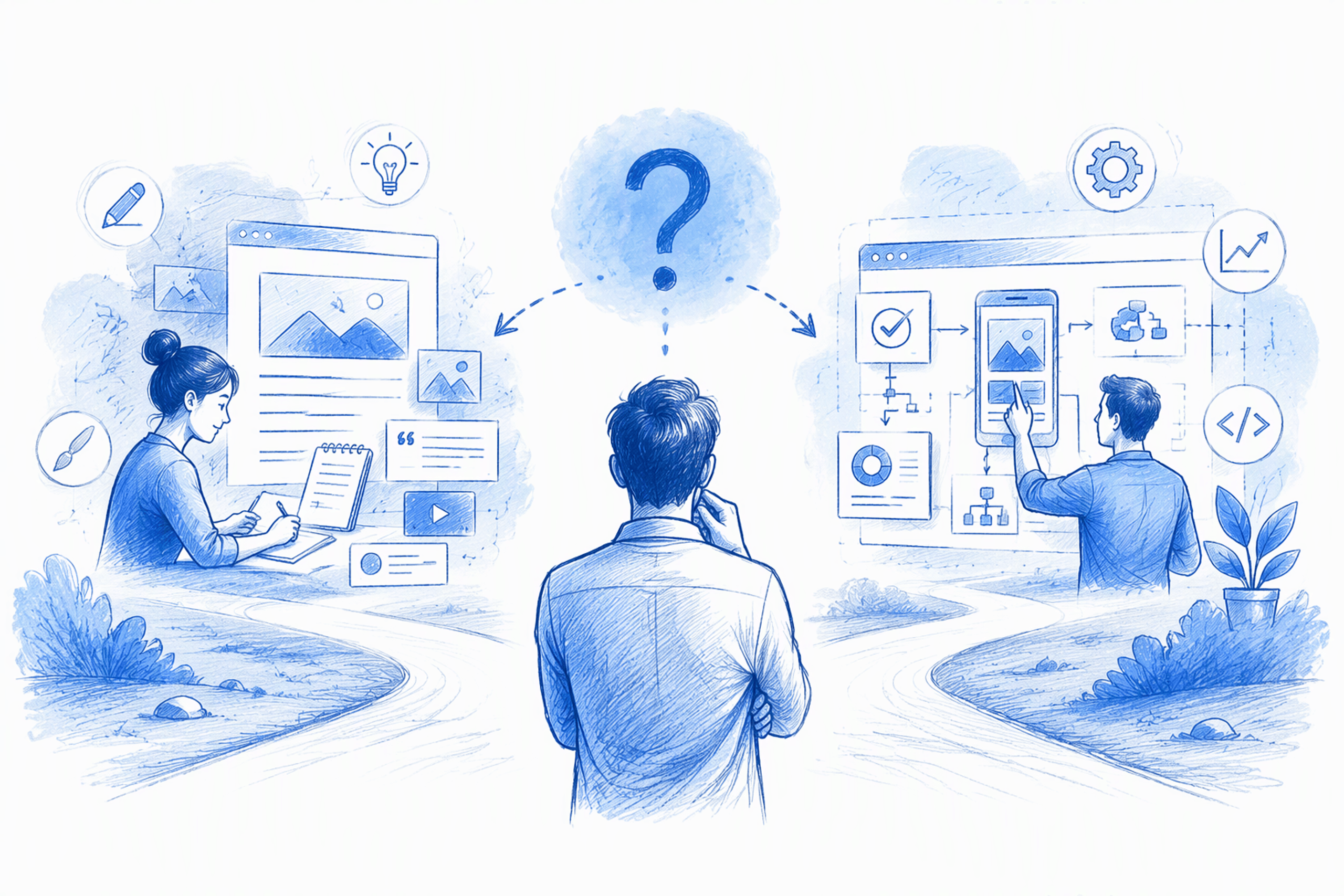
Hire for the problem and ownership required, not the most familiar job title. A freelance content designer is best suited to language systems, interface content, terminology, and governance. A freelance product designer is usually the stronger choice when flows, navigation, UI hierarchy, interactions, testing, and implementation also need work.
Table of Contents
- Freelance content designer or product designer: which problem are you hiring to solve?
- What does a freelance content designer actually do?
- When the real need is a freelance product designer
- Compare scope, outputs, and ownership before comparing rates
- How to evaluate a freelance designer beyond visual polish
- Why frontend knowledge changes the design outcome
- Questions to ask before hiring—and proposal red flags to avoid
- Where AI helps—and where product judgment still matters
- Choose the narrowest specialist who can still own the outcome
- FAQ
- Turn the brief into a buildable product
Freelance content designer or product designer: which problem are you hiring to solve?
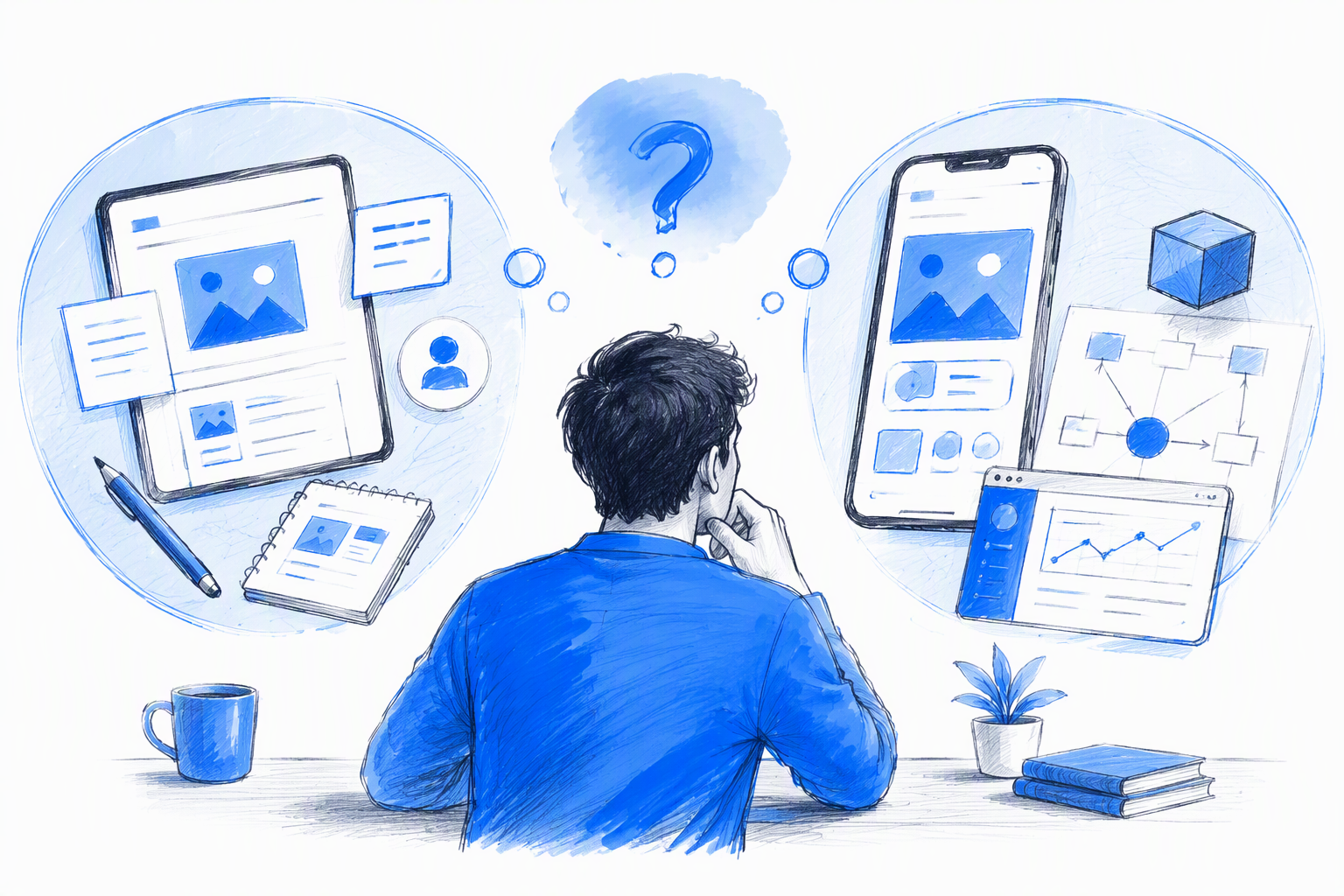
A content-heavy digital product does not automatically need a content-design specialist. Language may be only one symptom of unclear navigation, inconsistent UI, broken interactions, or a difficult design-to-development handoff. In that situation, a narrowly scoped hire can leave the underlying problem untouched.
We recommend content design when the central challenge is language structure, terminology, standards, or governance. Choose a freelance product designer when flows, information architecture, interactions, interface hierarchy, testing, and delivery are also part of the brief.
This guide focuses on digital products. Physical products and manufactured objects require a different discipline.
A quick hiring test
Ask: Can we achieve the desired outcome by changing language and content structure without redesigning how the product works?
If yes, hire a freelance content designer. If not, the brief probably requires broader product-design ownership.
Consider a SaaS onboarding flow with accurate copy but poor completion. Unnecessary steps, weak hierarchy, unclear states, or awkward interactions cannot be fixed by rewriting labels alone.
What does a freelance content designer actually do?
A content designer shapes the language, structure, sequence, and governance of information around user needs. The role goes beyond freelance content writing because it considers how content works across an experience, not just whether individual sentences read well.
Typical outputs include:
- Content audits and inventories
- Content models and naming systems
- Interface copy and error messages
- Onboarding language
- Voice and tone guidance
- Terminology standards
- Testing recommendations
- Governance and localization guidance
Content design also differs from graphic design. A graphic designer primarily communicates visually. A content designer decides what information people need, when they need it, and how it should be structured.
Unless agreed otherwise, ownership usually stops before complete visual systems, complex interaction design, deep prototyping, or frontend implementation.
When specialist content design is the right hire
Specialist content design is particularly useful when terminology, consistency, accessibility, localization, or governance creates operational risk. Instead of correcting isolated strings, the designer can establish reusable standards.
It also suits established teams with UX, UI, research, product management, and engineering already covered. The specialist can then concentrate on content quality without becoming responsible for the whole product experience.
What a content designer should not be expected to own alone
Unless the scope explicitly includes it, a content designer should not be solely responsible for:
- End-to-end navigation redesign
- Complex product interactions
- A complete visual design system
- Technical feasibility decisions
- Responsive interface behavior
- Production frontend work
Assigning all these responsibilities to one specialist creates unclear accountability rather than efficient collaboration.
When the real need is a freelance product designer
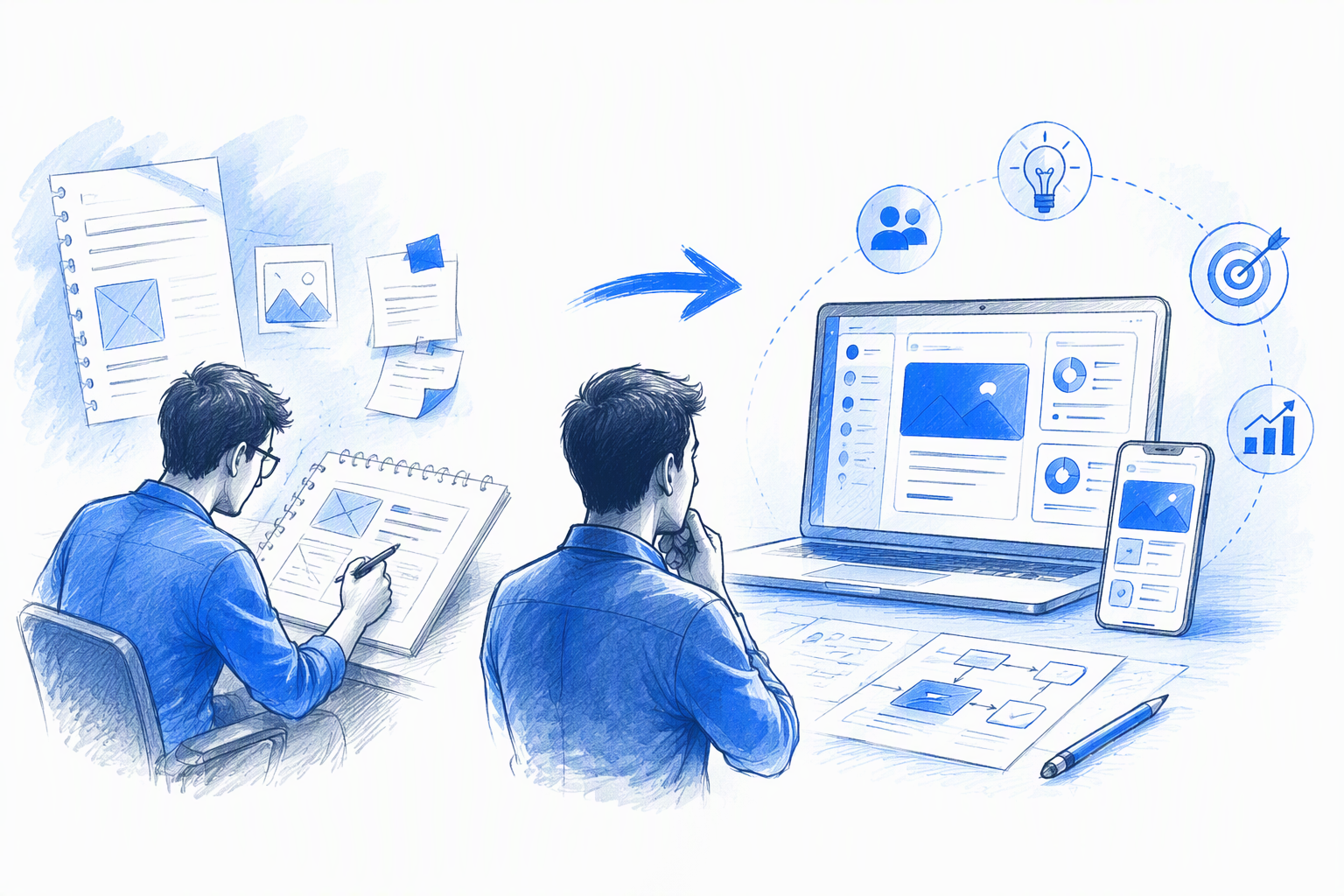
Product design connects the whole experience. User flows, information architecture, wireframes, interaction design, UI systems, prototypes, testing, and implementation guidance must work together.
This approach suits founders and product teams whose content problems are tied to usability, conversion, hierarchy, or shipping feasibility. An early-stage MVP may benefit from one senior designer connecting discovery to build-ready specifications instead of several disconnected specialists.
Our approach at amajaying.com combines UX thinking, distinctive UI craft, and frontend awareness. That gives teams a direct route from an uncertain product problem to a buildable experience.
For a closer look at the operating model, see how freelance product design turns product problems into shipped experiences.
Signs your content problem is really a product problem
The scope probably needs product design when:
- People cannot find the right action even though the wording is accurate.
- The journey contains unnecessary steps or unclear system states.
- Mobile hierarchy weakens otherwise strong messaging.
- Interaction patterns change unpredictably between screens.
- Engineering repeatedly has to reinterpret impractical designs.
- The team cannot separate copy problems from flow problems.
Clear messaging cannot compensate for poor responsive hierarchy, weak calls to action, or frustrating interactions. Content and experience quality are connected, but they are not interchangeable.
What end-to-end ownership should include
A strong engagement defines discovery boundaries, decision rationale, testable flows, responsive behavior, edge cases, UI direction, and frontend-ready guidance.
Ownership should continue beyond Figma approval. Implementation support helps teams resolve real constraints without forcing engineering to guess what can flex and what should remain intact.
Compare scope, outputs, and ownership before comparing rates
Headline rates mean little without scope. We prefer to compare what each option owns, how decisions will move, and how much coordination the client must provide.
| Option | Best use case | Typical outputs | Ownership |
|---|---|---|---|
| Freelance content designer | Terminology, interface content, content systems, governance | Audits, models, UI copy, standards | Focused content layer |
| Freelance product designer | Connected UX, UI, interaction, and delivery problems | Flows, prototypes, UI systems, specifications | End-to-end digital experience |
| Agency | Programmes requiring parallel capacity | Multi-role strategy and production | Distributed across a team |
| In-house hire | Stable, ongoing product work | Continuous product design | Embedded long-term ownership |
Searches for a freelance content designer salary often reflect employment rather than project-buying intent. Salary benchmarks do not directly predict freelance costs, which depend on scope, risk, duration, availability, and dependencies.
Commercial models may include day rates, fixed project fees, paid discovery work, and retainers. The right model depends on uncertainty and how likely the scope is to change.
Freelancer vs agency vs in-house
A senior freelancer can provide direct attention and continuity from problem framing to handoff. An agency’s main advantage is access to broader capacity and multiple roles, although that does not automatically produce better work.
An in-house designer makes sense when product direction and workload are stable. During uncertainty, a permanent hire can be a large commitment before the team fully understands the role it needs.
Our comparison of hybrid designers, agencies, and in-house teams examines these differences in more detail.
What should be explicit in every estimate
Every estimate should define:
- Deliverables and exclusions
- Communication and feedback cadence
- Revision boundaries
- Client and technical dependencies
- Handoff format
- Implementation support
- Change-request handling
- Approval responsibilities
A low fixed fee with unlimited revisions can conceal unclear decisions, weak timelines, and limited implementation support. Any initial saving may disappear through rework.
How to evaluate a freelance designer beyond visual polish
Treat portfolio review as a commercial assessment, not a taste test. Attractive screens do not prove that a designer understood the problem, managed constraints, or helped ship the result.
Look for user context, alternatives considered, trade-offs, outcomes, and evidence of implementation. Our guide to product designer portfolio examples provides a deeper evaluation framework.
When several disciplines appear in one case study, ask what the designer personally owned. Research, writing, engineering, and agency support should be credited clearly.
Questions a strong case study should answer
- What changed for users or the business?
- Which constraint shaped the solution?
- What was tested or rejected?
- How did implementation affect the design?
- What did the designer personally own?
- How was momentum maintained?
The answers should demonstrate judgment, not just present a polished process.
Portfolio red flags
Watch for:
- Attractive mockups with no product context
- No constraints, rejected options, or shipped evidence
- Generic process diagrams repeated across projects
- Unclear personal contributions
- Impact claims without evidence or qualification
- Interfaces that ignore responsive and edge-case behavior
Evidence of ownership matters more than confident presentation.
Why frontend knowledge changes the design outcome
Frontend awareness improves design decisions before handoff. It helps account for responsive behavior, component logic, loading and error states, accessibility, and technical constraints.
Fewer translation steps between UX, UI, and development can also surface problems earlier. For us, the value is continuity: UX establishes the structure, distinctive UI creates character, and build-aware execution keeps the experience realistic.
Fewer handoffs, faster feedback
One accountable designer can resolve UX, UI, and feasibility questions without routing every issue through several roles. Collaboration remains essential, but avoidable translation is reduced.
Engineering should receive guidance on:
- Component behavior
- Responsive priorities
- Empty, loading, success, and error states
- Interaction rules and edge cases
- Accessibility expectations
- Areas where implementation may flex
The handoff should support decisions, not merely provide static screens.
Questions to ask before hiring—and proposal red flags to avoid
A practical interview should cover availability, process, communication, revisions, handoff, implementation support, and success measures. It should also establish who has final decision authority.
Use this product design freelance hiring checklist before signing a contract.
Red flags include vague scope, unexplained timelines, unlimited revisions, missing dependency assumptions, and a handoff that ends with static Figma files.
Questions to ask the designer
Ask:
- What will you own, and what must our team provide?
- How will you validate the flow before adding visual detail?
- How will progress and risks be communicated?
- How do you account for frontend constraints?
- What implementation support is included?
- What happens when priorities change?
- How are revisions separated from change requests?
- What evidence will define success?
Strong answers should respond to the actual engagement, not repeat a generic process.
What to prepare before kickoff
Prepare the product goal, available user evidence, analytics, technical and commercial constraints, timeline, and success criteria.
We also recommend appointing one empowered approver. Fast feedback depends less on constant meetings than on clear authority.
Where AI helps—and where product judgment still matters
AI can support content variants, research synthesis, rapid exploration, documentation, and repetitive production. Used carefully, it leaves an experienced designer more time for analysis and decision-making.
Generated copy or interfaces are not validated solutions. They may be generic, inconsistent, inaccessible, or poorly matched to technical and organizational constraints.
The work AI cannot own
AI cannot be accountable for:
- Choosing the right problem
- Balancing conflicting constraints
- Building stakeholder agreement
- Evaluating commercial and technical trade-offs
- Deciding what evidence is sufficient
- Supporting implementation
- Owning the shipped result
We treat AI as a tool within a human-led process, not a substitute for senior ownership.
Choose the narrowest specialist who can still own the outcome
Hire a freelance content designer for a focused content-system problem. Hire a freelance product designer when the experience must be reshaped across UX, UI, interactions, and delivery.
Teams creating manufactured objects may instead need a freelance industrial designer. Our guide to choosing between a freelance industrial designer or product designer explains that physical-versus-digital distinction.
A simple next step
Start with the product goal, existing evidence, constraints, timeline, and intended outcome. These inputs make it easier for us to identify whether the work needs content expertise, broader product ownership, or a focused discovery engagement.
FAQ
What does a content designer do?
A content designer structures information around user needs. Their work may include interface copy, audits, terminology systems, onboarding language, error messages, content models, accessibility guidance, and governance.
How can I become a freelance content writer?
Build strong writing and editing skills, choose a commercial niche, and create samples that show useful outcomes. Learn research, briefing, revisions, contracts, and client communication. Content writing differs from content design, although experience with user journeys and interface language can support a move into product work.
Is AI replacing freelancers?
AI is changing production work, but clients still need context, judgment, specialist craft, stakeholder management, and accountability. Those skills are especially valuable when work affects usability, technical feasibility, or business outcomes.
What does a freelance graphic designer do?
A freelance graphic designer creates visual communication such as brand identities, campaigns, presentations, packaging, and marketing assets. Some also design interfaces, but product design usually requires broader ownership of flows, interactions, testing, systems, and implementation constraints.
Turn the brief into a buildable product
We combine UX thinking, distinctive UI, and frontend awareness for teams that need senior digital-product ownership without agency layers. Share the product goal and constraints with us, and we’ll help identify the right scope.