Portfolio product design: 10 ways to prove judgment, execution, and impact
Build a portfolio product design story that shows sound judgment, polished execution, clear ownership, and measurable impact. Explore 10 practical ways.
By Ajay Khatri ·

TL;DR
Process is not proof. A strong portfolio product design story gives hiring teams credible evidence across four areas: product reasoning, visual craft, production execution, and impact. We recommend leading with the result, making ownership explicit, and showing deeper process only when it explains an important decision.
Table of Contents
- What a strong portfolio product design story must prove
- Use a five-line product design portfolio template
- Build each case study around one consequential decision
- Connect UX and UI decisions to measurable impact
- Make ownership and collaboration impossible to misread
- Prove systems thinking and frontend execution
- How to review product design portfolio examples
- Publish credible case studies even under an NDA
- A concise checklist for an impact-driven design portfolio
- FAQ
- Explore impact-driven product design work
What a strong portfolio product design story must prove
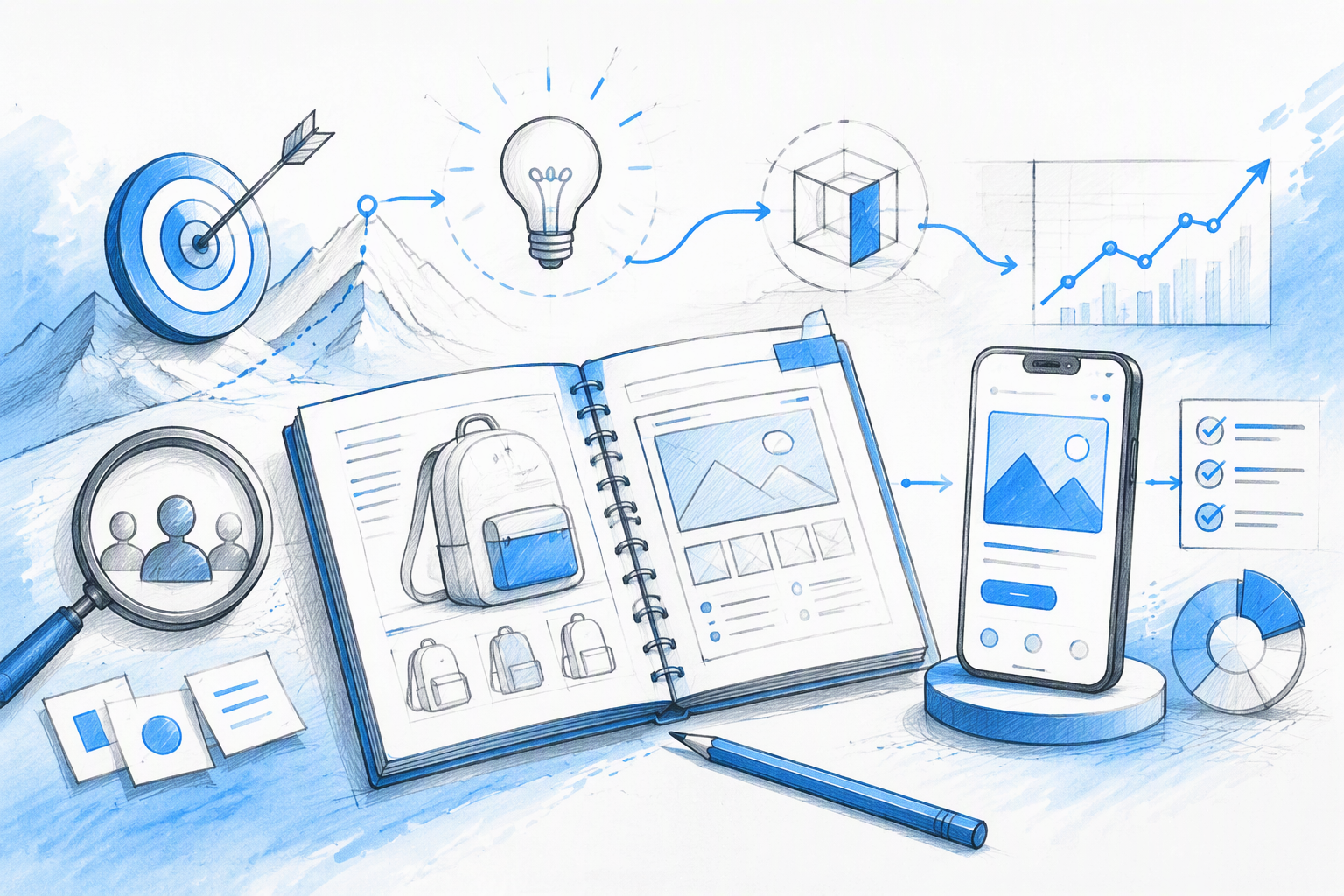
Process is not proof. A portfolio packed with personas, journey maps, workshop photos, and polished screens can still leave one basic question unanswered: what did this designer actually change?
We treat a portfolio as a product for busy hiring managers, founders, and product teams. Its structure should help readers identify the strongest evidence quickly, then explore the reasoning behind it when relevant.
Each case study should demonstrate four distinct evidence layers:
- Product reasoning: A specific problem, credible evidence, considered options, and a defensible decision.
- Visual craft: Clear hierarchy, thoughtful interaction, distinctive UI, and appropriate content.
- Execution: Responsive behaviour, component states, accessibility, technical feasibility, and production decisions.
- Impact: A shipped outcome and an observable change for users or the business.
Attractive screens demonstrate visual capability, but they do not automatically prove product judgment. Without a clear problem, personal contribution, consequential decision, or outcome, they provide weak hiring evidence.
Design for a quick scan
A hiring manager may open a portfolio between other tasks. Outcome-led project titles, concise summaries, visible ownership, and clear results should appear before a long process narrative.
Use progressive disclosure: place the strongest proof first, then add research details, explorations, and implementation context further down. Our guide to product design portfolio examples that pass the 30-second hiring scan shows how this hierarchy can support faster evaluation.
Judge evidence before aesthetics
Evaluate the problem, contribution, shipped quality, and result separately. A beautiful speculative redesign should not automatically outrank a less glamorous project that shipped, addressed real constraints, and improved a meaningful outcome.
Visual polish matters. It simply cannot substitute for decision quality. Strong portfolio work proves both.
Use a five-line product design portfolio template
A repeatable project snapshot prevents readers from hunting for basic context. We recommend placing it above the first major visual so it works for both fast scanners and people reading the complete case study.
Our portfolio product design template covers the product and problem, role, team, constraints, and outcome in five concise lines.
The project snapshot
Use a format like this:
- Product and problem: An AI workflow tool had weak activation because new users struggled to reach a useful first output.
- My role: I led product definition and interaction design and contributed to the production UI.
- Team: I partnered with the founder on prioritisation and worked with engineering on feasibility and implementation.
- Timeline and constraints: The team faced limited engineering capacity, a fixed launch date, and uncertain AI responses.
- Outcome: The revised experience shipped and helped users reach the product’s core value with less initial configuration.
Treat this as a framework rather than a script. Each line should contain project-specific information, not generic portfolio language.
“Designed the UX/UI” is not an ownership statement. Specify what we led, where we contributed, and what teammates owned. For a more detailed structure, see this practical product design portfolio sample and hiring review.
Replace the generic hero mockup
A decorative laptop mockup shows the interface but rarely reveals the intervention. Lead instead with a before-and-after flow, a simplified workflow, or the product behaviour that changed.
Captions should explain significance rather than merely label screens. “New onboarding” says little. “The revised flow lets users generate a useful first output before configuring advanced settings” communicates the underlying product decision.
Build each case study around one consequential decision
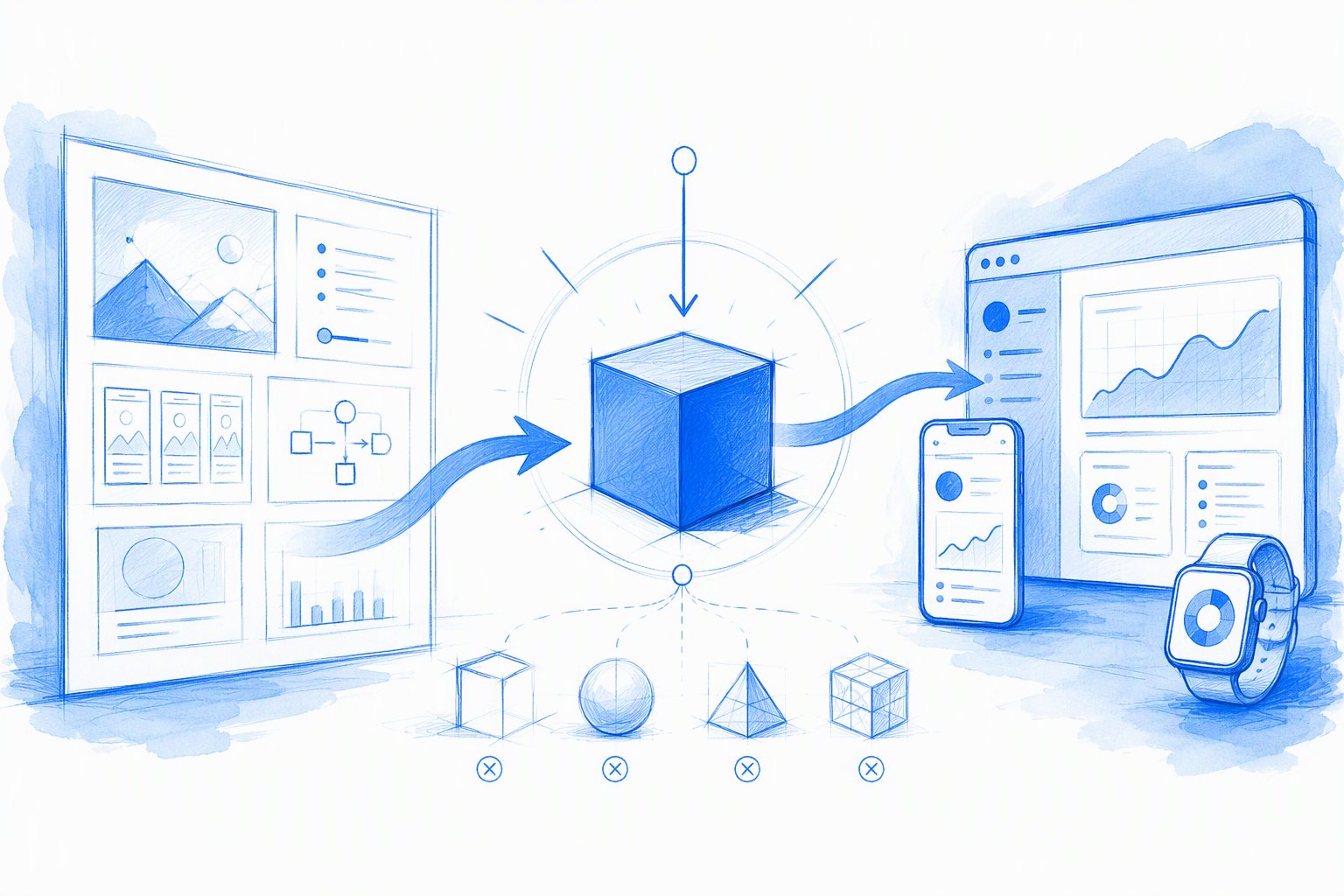
Strong product design portfolio examples do not document every activity with equal weight. They build the narrative around one consequential decision and show:
- What evidence was available
- Which options were considered
- What was selected and why
- What changed after release
Personas, journey maps, and workshop photos belong only when they influenced that decision. Otherwise, they create process theatre rather than proof.
Show the constraint that shaped the work
Constraints reveal judgment. Limited engineering capacity, a fixed deadline, weak activation, uncertain AI output, or incomplete data can materially affect scope and interaction design.
Explain the response. We might reduce an initial release to one activation path, introduce a recoverable uncertain state, or postpone an expensive feature until user behaviour supports further investment.
Avoid mentioning constraints as background decoration. Show how each one changed the design, priority, or delivery plan.
Include rejected directions
Real product work is rarely linear. Compare viable options and explain why one lost based on user value, business priority, feasibility, risk, or timing.
For example, personalised onboarding might demand substantial implementation work without strengthening the core activation moment. Showing why the team rejected it demonstrates prioritisation, not failure.
The alternatives need enough detail to feel credible, but they should not overwhelm the selected direction.
Know when to stop discovering
Endless discovery is not inherently user-centred. Research becomes useful when it reduces uncertainty enough to support responsible action.
A credible narrative identifies that threshold: the available evidence supported a decision, a scoped release, measurement, and iteration. Our framework for building product design case studies hiring teams trust explains how to retain depth without documenting every exercise.
Connect UX and UI decisions to measurable impact
“I improved the user experience” is too vague. Connect a specific intervention to a relevant outcome, such as activation, adoption, retention, revenue, conversion, efficiency, or reduced support demand.
The relationship should be credible rather than inflated. Design often contributes alongside engineering quality, product strategy, marketing, pricing, customer support, and market conditions.
Frame commercial impact honestly
Commercial traction can strengthen a case study when the connection to product work is explained carefully. It should not be presented as proof that design alone generated growth.
A useful case study identifies the decisions that supported the outcome: clarifying the product’s value, helping users reach an effective first result, handling uncertain AI behaviour, or reducing friction in a key workflow. Where approved data is available, pair a business result with the most relevant product behaviour, such as activation, repeated use, or conversion.
We recommend language such as “the redesigned activation flow contributed to improved conversion” rather than “the redesign caused revenue growth.” The first acknowledges the relationship without claiming single-cause success.
What to show when exact numbers are confidential
Confidentiality does not require empty impact statements. With permission, a case study may use:
- Percentages or indexed improvements
- Approved ranges
- Directional movement
- Proxy metrics
- Qualitative feedback
- Reduced steps, time, errors, or support demand
State the limitation plainly. “Activation improved after launch, but the exact figure is confidential” is more credible than “the redesign was highly successful.”
If no measurement took place, say so. Describe what shipped, what feedback was observed, and what we would measure next instead of inventing certainty.
Make ownership and collaboration impossible to misread
Team outcomes should not become one-person success stories. A senior product design portfolio needs to clarify individual contribution while showing how the designer worked with founders, engineers, researchers, marketers, and product managers.
Collaboration is not a meeting list. It is evidence of influence, alignment, negotiation, and execution.
Use led, contributed, and partnered precisely
Use these terms deliberately:
- Led: Decisions, activities, or deliverables for which we held primary responsibility.
- Contributed: Work completed alongside another owner or specialist.
- Partnered: Shared decisions requiring meaningful cross-functional alignment.
Name where someone else held final authority. Where appropriate, include productive disagreements, the evidence each side brought, and how the team resolved technical or commercial trade-offs.
An effective statement might read: “I led product definition and interaction design, partnered with the founder on prioritisation, and worked with engineering on production trade-offs.”
What staff-level evidence looks like
Staff-level work extends beyond producing a strong flow. It can demonstrate strategic framing, cross-functional leverage, mentorship, systems impact, and sound decisions under ambiguity.
Show how one decision influenced a roadmap, reusable platform capability, team practice, or design system. The evidence should reveal organisational leverage, not simply a larger collection of screens.
Prove systems thinking and frontend execution
Static Figma screens represent an ideal state. Production products must also handle different devices, content lengths, permissions, failures, delays, and technical limitations.
A product design engineer portfolio should show how design intent survived contact with production. That is central to our hybrid approach at amajaying.com: combining UX thinking, distinctive UI craft, and frontend awareness.
Document behaviour, not only screens
Include relevant system states:
- Loading, empty, error, and success
- Disabled and permission-restricted states
- Long, missing, or malformed content
- Uncertain or low-confidence AI output
- Responsive transformations across important viewport sizes
Explain accessibility decisions involving hierarchy, contrast, focus visibility, keyboard behaviour, and motion. These details show whether the experience works beyond the presentation frame.
Do not add every possible state simply to make the project look comprehensive. Focus on the states that created meaningful design or implementation challenges.
Show how design became production
Include live interactions, implementation notes, prototypes, or selected frontend details where appropriate. Discuss component reuse, browser behaviour, performance considerations, and compromises made with engineering.
This does not require publishing an entire codebase. It requires evidence that the designer understood technical reality, communicated behaviour clearly, and helped protect the experience through implementation.
How to review product design portfolio examples
Lists of attractive sites are easy to browse but hard to use. We recommend evaluating product design examples of portfolio work with a consistent scorecard rather than ranking them by prestige, visual trend, or project count.
Behance-style presentation can demonstrate visual craft, but it may not reveal ownership, constraints, responsive behaviour, shipped execution, or impact. These product designer portfolio examples and hireability criteria provide a more evidence-led lens.
The four-part portfolio scorecard
Review each project across four dimensions:
- Product reasoning: Is the problem specific? Are important decisions supported by evidence?
- Craft: Are the hierarchy, interaction, visual system, and content clear and coherent?
- Execution: Does the work account for responsive behaviour, edge cases, accessibility, and technical reality?
- Impact: Did the work ship, and what changed for users or the business?
Keep these dimensions separate. A project can be visually impressive but strategically shallow, or commercially successful while poorly presented.
Curate a focused project selection
A small set of strong, role-relevant projects usually provides more useful evidence than an archive of every exercise completed. Choose complementary work: one project may foreground strategic judgment, another visual craft, and another production execution.
Tailor the order to the opportunity. A startup may value range and speed, while a mature product team may look for systems thinking, collaboration, and experience with complex constraints.
Adjust the standard by career stage
For an undergraduate portfolio, self-initiated projects are valid when they contain a credible constraint, explicit decisions, and honest reflection. Do not fabricate client conditions or business outcomes.
For a product design engineer portfolio, weigh feasibility, systems, prototyping, and implementation more heavily. For a staff product designer portfolio, look for influence extending beyond one feature or flow.
Publish credible case studies even under an NDA
An NDA does not automatically require a vague case study, but permission must come first. Confirm what can be disclosed before publishing client work, metrics, interfaces, or internal details.
With approval, sanitisation can preserve useful evidence without exposing confidential information. It must never imply permission that has not been granted.
What can still be shown
Depending on the agreement, an NDA product design portfolio may include:
- Anonymised user or business actors
- Reconstructed or simplified workflows
- Blurred or replaced data
- Abstracted system diagrams
- Approved directional outcomes
- Decision logic and constraints
- A clearly defined role and collaboration model
Label reconstructed or sanitised visuals explicitly. Readers should understand which material reflects shipped work and which has been recreated for explanation.
What not to invent
Never fabricate metrics, quotes, research activity, or shipped status. Do not present an unsolicited or speculative redesign as a real client outcome.
State the boundary confidently: “The interface and metrics are confidential, so this case study focuses on my role, decision logic, and an approved directional result.” Clear limitations build trust when the judgment remains specific.
A concise checklist for an impact-driven design portfolio
Less process theatre, more proof. Before publishing, we recommend confirming that each case study includes:
- A concise project snapshot
- A specific user or business problem
- Explicit personal ownership
- One consequential decision
- A real constraint
- At least one credible alternative
- Relevant responsive and system states
- Accessibility and technical considerations
- Evidence of implementation or shipped behaviour
- A measurable, directional, or honestly limited outcome
The strongest evidence should appear before the deeper narrative. Supporting artefacts should earn their place by explaining a decision.
Before publishing, ask these questions
- Can a hiring manager quickly understand the product, problem, role, and result?
- Does every process artefact explain or support a decision?
- Can readers distinguish individual work from the team’s work?
- Does the case study show technical reality and shipped behaviour, not just ideal-state screens?
- Is the strongest project evidence visible before the deeper narrative?
FAQ
What should a product design portfolio include?
A product design portfolio should include a concise project snapshot, specific problem, personal role, key constraint, consequential decision, collaboration model, production evidence, and outcome. It should also show visual craft, responsive behaviour, edge cases, and accessibility where relevant. Every artefact should support a meaningful decision.
How many case studies should a product designer show?
We recommend a focused set of relevant case studies rather than every completed project. Together, they should demonstrate complementary strengths such as product strategy, UI craft, collaboration, systems thinking, and production execution. Quality, relevance, and credible evidence matter more than reaching an arbitrary total.
What makes a product design case study stand out?
A strong case study makes the intervention and result immediately visible. It explains what the designer owned, identifies a difficult constraint, compares viable directions, and shows why one option was selected. It also connects the shipped experience to measurable or directional outcomes without exaggerating causation.
Can a product design portfolio include confidential work?
Yes, but only within the permissions granted by the client or employer. Approved approaches may include anonymised actors, sanitised flows, reconstructed screens, blurred data, abstracted diagrams, and directional outcomes. Label modifications clearly, state disclosure limits, and never invent metrics, quotes, or results.
Do product designers need to show frontend knowledge?
Not every role requires coding, but frontend awareness strengthens evidence of production readiness. Responsive behaviour, component states, accessibility decisions, technical constraints, and implementation compromises all show how a designer approaches real products. Product design engineer roles should include deeper prototyping, systems, and implementation evidence.
Explore impact-driven product design work
See our design portfolio to explore how we combine UX thinking, distinctive UI craft, and frontend execution. Then contact us to discuss an impact-driven digital product for your team.